
Licensed & Insured · Since 1998
Our Passion is Transforming Your Backyard Vision into a Stunning Reality!
Next Door Neighborhood Favorite
Google and Yelp Reviews Below:

Pool Automation Repair in La Quinta, CA: When the App Spins and the Spa Never Turns On

Proven Excellence
Why won't my pool automation connect to the app?
Four things have to agree before your thumb turns on the spa.
It is nine at night. You are in the kitchen with a dish towel over your shoulder. You open the app, tap the spa button, and watch the little wheel spin. Then it quits. That is the call that starts most pool automation repair La Quinta jobs, and it almost never starts at the pool.
Walk the chain backward, one link at a time.
Link one is your phone and the app. It has to be logged in, updated, and pointed at your system.
Link two is your house wi-fi and internet. If the router rebooted, changed names, or the service is out, the app has nothing to talk to.
Link three is the hop between the house and the panel at the pad. Some are wireless, some are wired. Either way it has to stay open across the yard.
Link four is the panel itself, plus the relays inside it and the valve actuators it commands.
Three of those four have nothing to do with your pool. That is why so many "my automation is broken" calls end with no pool part replaced.
Here is the fast home test. Walk out and press the spa button on the panel itself. If the pool obeys pump changes note, valves swing, spa fills the pool is fine and the trouble is upstream. If nothing moves, the trouble is downstream. That one test splits every automation call in half.
Most of the time the pool is fine and the connection is not. The app talks to your wi-fi, your wi-fi talks to a link at the pad, and that link talks to the panel. Any one can drop while the pool runs fine. Press spa on the panel. If it responds, the problem is your network, not your pool.
What actually breaks in a pool automation system
The wireless link or antenna. The cheapest failure here. Antennas sit in full sun and blow-sand for years. A bridge that lost its pairing after a router change is a ten-minute fix.
The transformer or power supply. Also cheap. It turns house voltage into the low voltage the board runs on. Desert heat inside a closed panel is hard on it.
Relays that stick. A relay is just a switch that clicks. Every time your schedule starts the pump, one clicks. Do that twice a day for a decade and the contacts burn. A stuck relay looks like a pump that will not shut off.
Valve actuators that stop turning. Small motors on top of the valves, and the most common physical failure at the pad.
Temperature sensors that drift. One reading ten degrees off makes a heater short-cycle or refuse to run. Cheap part, big symptom.
A control board cooked by sun. The expensive one. Years of afternoon sun on a pad with no shade bakes a board. Boards run [[PRICE_control_board]], and on an older system that price gets close to a newer setup. Five of those six are cheap parts. Only the last is the board.
The spa says on, the jets run, and the water never warms
This is the most common automation complaint, and it fools people into calling for a heater.
When you press spa, the panel tells a valve actuator to rotate the valve and send water to the spa. The jets you hear are just the pump pushing water. If the actuator did not turn, water is still circulating through the pool, so the heater warms the whole pool by a fraction of a degree while your spa sits lukewarm.
You can check it without touching anything electrical. Press spa, then look at the valve handles at the pad. The actuator should hum and the handle should rotate a quarter turn.
This overlaps with heater calls constantly. If the spa heats fine with the valves turned by hand, it is an automation problem. If it still will not warm, read the pool heater repair in La Quinta page instead.
Swimming pool automation and controls repair



Swimming pool timer repair
A lot of valley pads still run an old dial time clock with metal trippers you slide around the face. Simple, and they last. When one dies, swimming pool timer repair is often a new mechanism or a new set of contacts, done in one visit for less than any controller.
Sometimes a straight timer repair is the better spend. If you live here full time, run a simple schedule, and have no spa and no heater, a dial clock does the job. Automation earns its keep when one of these is true.
Power rates. A controller shifts pump hours off peak-rate windows and still holds turnover in 115-degree summer weather.
Freeze protection. La Quinta gets cold nights in December and January. A controller watches air temperature and starts the pump so water keeps moving. A dial clock cannot.
The house sits empty. If you are gone half the year, remote control is the whole point.
If only the clock failed, the pool timer repair in La Quinta page covers that smaller job.
Electrical repair
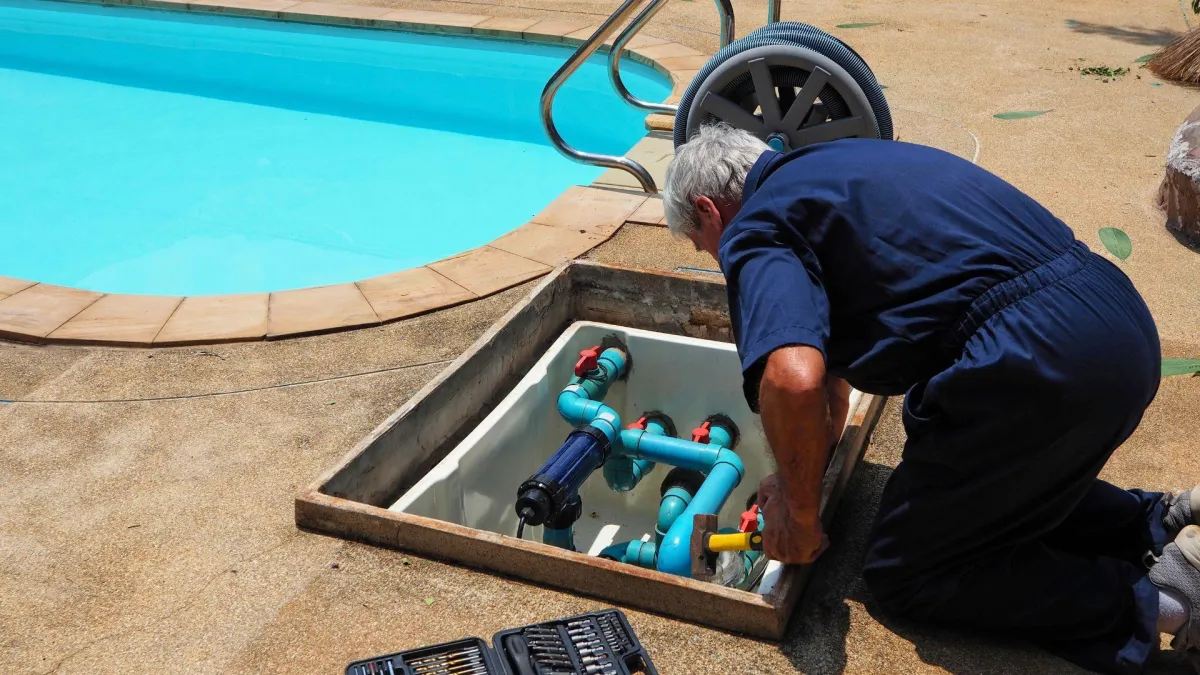
An automation panel is not a thermostat. One box holds line voltage feeding the relays, low voltage running the board and sensors, and the bonding grid tying the metal at the pad together. Electrical repair on that box is licensed work. CSLB 994121
Bonding is the part homeowners have never heard of. Under CEC Article 680, the metal around a pool pump motor, heater, ladders, rebar, equipment at the pad gets tied together with heavy copper so nothing sits at a different voltage. When a panel gets swapped in a hurry, the bond wire is the piece left off.
GFCI tripping is its own family of symptom. If the GFCI trips every time the pump starts, or trips overnight and you find everything dead by morning, that is not the automation being fussy. That is current going somewhere it should not often a pool light, a wet junction box, or a motor with moisture in the windings. Do not keep resetting it. Read the pool electrical repair in La Quinta page, then call.
Swimming pool equipment repair and pool automation repair La Quinta calls keep running into each other. A controller does not move water. It tells a pump, heater, valve, light, and salt cell what to do, then reports what they said.
That is why a good automation call includes the whole pad. A variable-speed pump that lost its communication cable shows an error in the app even though the motor is perfect. A heater locked out on its own safety reads as a heater fault when the real problem is a dirty filter starving it for flow.
Monsoon wind from July through September packs fine sand into cabinets and cooling vents, and that alone causes a run of communication faults every late summer. The pool equipment repair in La Quinta and pool pump repair in La Quinta pages cover each piece.
General repairs
General repairs is where the odd stuff lands. A cracked panel door that let rain and sand in. A conduit a landscaper's trencher clipped. Rodent damage to low-voltage wire, common at pads with heavy shrub screening. Sun-rotted labels, so nobody knows which relay runs what.
Light control is a common one. Color lights take timed power pulses to change color, and when a relay gets lazy they land on the wrong color or refuse to sync. That is a relay or light problem, not the app. The pool light repair in La Quinta page covers it. If you are not sure which category your problem fits, describe it in plain words on the phone.
What remote control is worth when nobody is at the house
Plenty of pools here belong to people who are somewhere else. Snowbirds gone May to October. Second homes. Short-term rentals with new guests every weekend. For those houses, remote control is not a luxury. It catches four problems before they get expensive.
A pump that stopped. In July, a pool with no circulation goes green in about four days. If you can see run status on your phone from Seattle, you catch it on day one.
A heater somebody left on. Guests turn the spa on and leave. Nobody notices for a week.
A freeze night in January. Alerts and freeze protection matter more on an empty house, since nobody is there to hear the pump not running.
A fill valve running. Summer evaporation here takes about a quarter inch a day, so auto-fill gets used hard. A stuck one runs your water bill up quietly.
The workflow that works: you keep the app, your caretaker or property manager gets access too, and both of you get the alerts. Somebody local can then check the pad the same day
Pool automation repair across La Quinta
The shop is on Avenida Bermudas, so most of these calls are a short drive
The Village at Old Town rental blocks. Dense with short-term vacation rentals, and that changes the job. Guests find the panel and change settings. Owners live out of state. Half the calls start with "it worked last week" and end at a schedule somebody overrode Saturday night. The real work is locking the panel, restoring the schedule, and getting the manager app access.
The Dune Palms Road corridor. Newer construction, and nearly every pad has a controller from day one. The failures are the boring ones actuators, relays, sensors and parts are still current.
The Avenue 54 corridor. Big lots. That is the whole story. The house sits at one end and the pad way out on the far side, so house wi-fi arrives weak or not at all. People assume the panel is broken when the fix is a better link between house and pad.
One more La Quinta detail. HOA rules here often cover exterior equipment, screening around the pad, and anything mounted where the street can see it. If a panel or antenna has to move for signal, check with the HOA first.
Ready to get the app talking to your pool again?
CV Pools has been fixing equipment on La Quinta pads since 1998, out of the shop at 52115 Avenida Bermudas, La Quinta, CA 92253. Hours are Monday through Friday, 6:00 AM to 9:00 PM.
Here is how a pool automation repair La Quinta visit works. The diagnostic is $150, credited toward the repair once you approve it. A tech tests the same chain you did, only with a meter — power at the panel, low voltage at the board, signal out to the relays and actuators then says which link is broken and what the part costs.
Call (760) 619-2409, or send details through the contact page for CV Pools in La Quinta. Before you call, do the panel test. Knowing whether the panel obeys saves everybody time.
See the rest of what a tech handles on the swimming pool repair service in La Quinta page, or browse all swimming pool services in La Quinta.
Transform Your Backyard into a Stunning Oasis with Our
Pool Repair and Construction Services
Revitalize your outdoor space with expert repairs that make your pool look brand new.
You deserve peace of mind knowing your pool repairs are handled by trusted experts.
Pool Equipment Check-Up 1 year maintenance Check-Up package to ensure long-term satisfaction.
Questions People Actually Ask
My pool app won't connect. Is my automation broken?
Usually not. Press the spa or light button on the panel at the pad. If the pool responds, the pool is fine and you have a network problem the app, your wi-fi, or the link out to the pad. If nothing moves, the panel needs a tech.
The panel works but the app doesn't. What do I check first?
Check whether your router changed its network name or password, since a rebooted router is the most common cause. Then confirm the app is updated and logged into the right account. Then check the antenna at the pad for sun damage.
I press spa and the jets run, but the water never gets warm. Why?
Your valve actuator probably did not turn. The pump runs, but water still goes through the pool, so the heater warms the whole pool a fraction of a degree. Press spa and watch the valve handle at the pad. If it sits still, the actuator needs replacing.
My schedule runs at the wrong time. Did something break?
Often the clock reset after a power outage, and daylight saving is the other culprit. Setting the time and date fixes it. If the schedule keeps sliding week after week, the board is losing memory, which points at a failing backup battery.
Does a dead control board mean I need a whole new system? Not always. On systems still in production, a board swap is a normal repair. On an older panel where boards are scarce, the price gets close to a newer setup, and a tech should say so.
Can I add automation to my old equipment, or do I have to replace everything?
You can usually add it. A controller runs a single-speed pump, an older heater, and existing valves as they are. You gain schedules, freeze protection, and remote control, but not variable-speed energy savings unless you change the pump.
Does my automation still work if my internet is down?
Yes. The schedule lives in the panel, not the cloud. Your pump, heater, and lights keep running their programs during an outage. What you lose is the app — remote control and alerts. That is also why panel buttons work when the app will not connect.
Can I control my pool from out of state?
Yes, and that is the main reason people here add automation. As long as the house has power and internet, you can run the pump, heater, and lights from anywhere and get alerts when something stops. Add your property manager to the account too.
My GFCI keeps tripping and now the automation is dead. What is that?
The GFCI is catching current leaking where it should not, usually a pool light, a wet junction box, or a motor with moisture inside. The panel losing power is a symptom, not the cause. Do not keep resetting it. Call.
Does freeze protection actually matter in La Quinta?
It matters a handful of nights a year, and those nights pay for it. December and January drop near freezing after dark. Freeze protection starts the pump by itself so water keeps moving through pipes and the heater
What does automation repair cost?
he diagnostic visit is $150, credited toward the repair once you approve it. After that it depends on which link failed.
Serving the Coachella Valley for the Past 27 years Committed To Providing the Best Experience
CV Pools Repair Services and Remodeling
All Rights Reserved © CV Pools Repair Services and Remodeling 2024
Website by
Facebook
Instagram
LinkedIn
Youtube
Website