
Licensed & Insured · Since 1998

Pool Pump Repair La Quinta: What Your Power Bill Already Told You

Proven Excellence
Our Passion is Transforming Your Backyard Vision into a Stunning Reality!
Next Door Neighborhood Favorite
Google and Yelp Reviews Below:
Why is my pool pump making noise or not turning on?
Pull up your electric account on your phone. Not the current bill the twelve-month graph. Most people who end up calling for pool pump repair La Quinta side of the valley already have that answer in their pocket and have never looked at it.
Do not look at the totals. Look at the shape of the line.
In a valley house, the pool pump is usually the second or third biggest load you own, behind the air conditioning. A single-speed motor spinning 3,450 RPM for eight hours a day in July pulls a flat, heavy, boring amount of power. Boring is good. Boring means healthy.
A failing pump does not pull less. It pulls more. A dragging bearing, or a motor fighting a blocked impeller, works harder to turn the same water. Harder means more amps, and more amps means a higher bill. That is why the bill usually turns before the noise starts.
Three shapes worth finding:
This July is taller than last July and nothing about your schedule changed.
You cut the timer back two or three hours and the bill barely moved.
The line has been flat and tall for years in a house built before 2000, which usually means 1998-era single-speed equipment.
The bill tells you something is wrong. It does not tell you what. That part takes somebody at the pad with a meter.
Nobody calls about a graph. They call about a sound, or about silence.
A pool pump makes noise or stops running for four common reasons: worn bearings inside the motor, air getting into the suction side so it cannot hold prime, a failed start capacitor that leaves it humming without spinning, or an electrical fault at the breaker, timer, or automation relay. The sound it makes points to which one. So does what it costs.
Those four problems are nowhere near each other in price. A capacitor is a small part. Bearings are a labor job. A burned-out motor on a fifteen-year-old wet end is usually a full pump replacement, since a new motor on a cracked housing buys a year at best.
That is the point of a diagnostic. Guessing at a supply house counter is how people buy a pump they did not need.
If your pump is off right now, leave the breaker off and call. Do not keep flipping it on to see if it catches. Restarting a seized or shorted motor turns a repair into a replacement. More on that in pool equipment repair in La Quinta.
Homeowners describe pump sounds better than they think. Here is the translation.
What the noise actually means
A high screech or squeal. Bearings. This is the classic pool pump making noise complaint. It starts as a morning chirp and grows into a scream you hear from the patio. Bearings are metal balls riding in grease, and heat and sand kill the grease. A screeching motor still moves water, so people live with it for months. That is how a cheap fix becomes a dead motor.
A gravelly rattle, or a basket full of air. Not the motor. That is air on the suction side, and it means your pool pump won't prime. Look for a low water level, a cracked lid o-ring, a loose drain plug, or a leak between the skimmer and the pump. Running a pump dry warps the seal and cooks the shaft.
A hum with no spin. Power is getting there and the motor cannot start turning. Usually a capacitor, sometimes a seized shaft. Turn it off. A humming motor is heating up.
A hot, sharp smell like an ironing board. Windings. The motor itself is burning. Kill the breaker.
Those four sounds sit at four very different prices.
Swimming pool equipment repair



Swimming pool equipment repair is the wider job, and the reason a good tech looks past the pump before quoting one.
A pump that keeps overheating is sometimes a pump problem. Sometimes it is a filter so packed that pressure climbed twenty pounds and the motor is straining. Sometimes it is a heater bypass valve half closed, or a salt cell plumbed in a way that chokes the return. Replace the pump without finding that and you get a second dead pump in two years.
The pad is one system: pump, filter, heater, valves, automation, and the pipe tying them together. When money is already going into a pump, that is the cheapest moment to fix a bad valve or a sun-rotted union.
If automation is what is failing, start with pool automation repair in La Quinta instead.
Pump repairs & installation
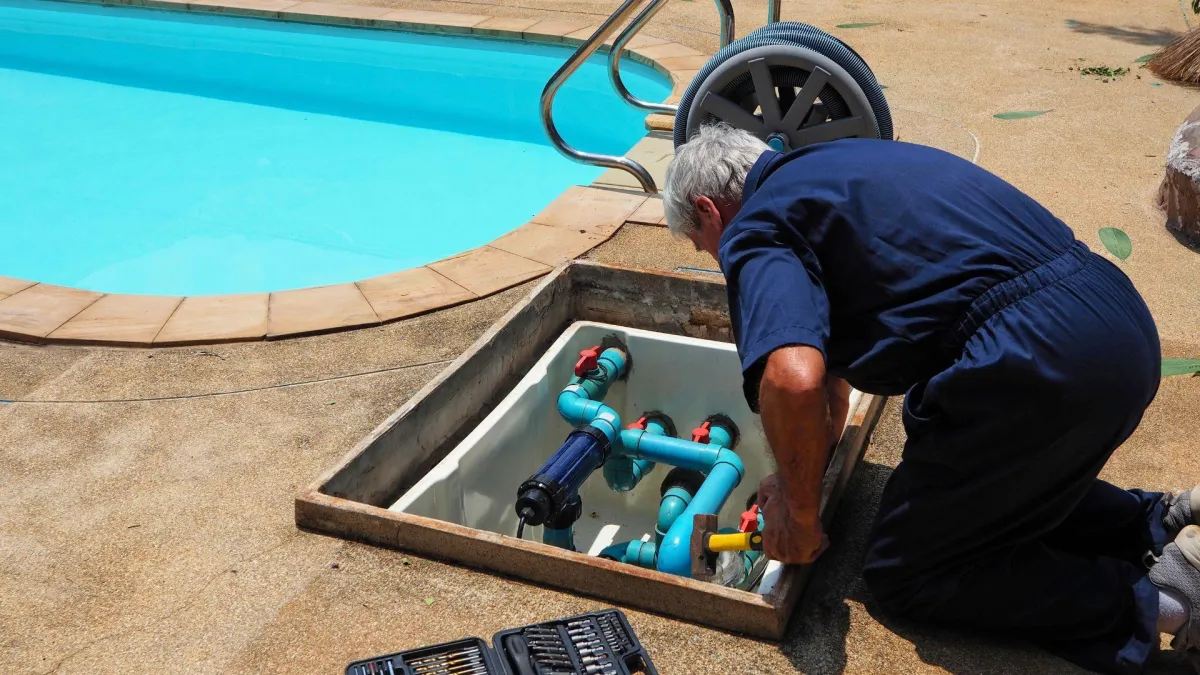
Pump repairs & installation covers the small stuff and the whole-unit swap, and honest pool pump repair La Quinta work means telling you which one you are in.
Repairs worth doing: shaft seals dripping onto the pad, lids and o-rings that will not hold a vacuum, a start capacitor, a fried terminal board, an impeller packed with pebbles and palm debris, a union gone brittle in the sun. Pool pump motor repair swapping the motor onto a sound housing makes sense when the wet end is clean and the plumbing is good.
Installation means pulling the old unit, correcting plumbing so the new pump is not fighting a bad elbow, wiring to code, setting speeds and schedule, and confirming it primes on its own after a power blip. That last step matters here, because valley houses lose power in monsoon wind events and nobody wants a green pool because the pump never restarted.
Swimming pool filter repair
Swimming pool filter repair belongs in any honest pump conversation, because a dirty or damaged filter is a top cause of a pump that runs hot and quits.
Blow-sand is the local villain. A monsoon wind event can load a cartridge in one night. Homeowners see the pressure gauge climb and the return jets go weak, and they assume the pump is dying. Often the pump is fine and screaming for help.
Torn cartridges, cracked manifolds, blown sand-filter laterals, and split DE grids all push debris back through the returns and drop flow. Clean or replace the media and the pump's amp draw falls the same day.
Full detail is on the pool filter repair La Quinta page.
Electrical repair
Electrical repair is where a fair number of "my pump is dead" calls actually end.
A tripping GFCI, a corroded breaker in a sun-baked subpanel, a timer with pitted contacts, a bonding wire rotted off the motor lug, a junction box that filled with water in a July storm any of those stops a healthy pump cold. Ground fault families show up on older pads where the conduit has cracked.
This is the one area where the honest advice is do not touch it. Pool equipment sits in a wet, bonded environment with its own section of the electrical code. Homeowner wiring at a pool pad is dangerous in a way an o-ring is not.
Licensed under CSLB 994121. For timer-specific problems, see pool timer repair La Quinta or pool electrical repair La Quinta.
General repairs
General repairs is the catch-all the three or four small things found while the water was already off.
Cracked knife valves. A three-way diverter that no longer diverts. Gauges that read zero no matter what. Plumbing glued at an angle years ago that has been side-loading the pump ever since. Chalky PVC that snaps the next time somebody turns a valve.
None are emergencies alone, and all are cheaper while a tech is at the pad. If a line under the deck is the real problem, that becomes pool plumbing repair in La Quinta or a pool leak detection La Quinta visit.
Repair it or replace it, and what California law does to that choice
This is the conversation nobody explains straight.
The old rule of thumb was simple: fix it if the repair costs less than half a new pump. California changed the math.
Under state appliance efficiency rules Title 20, with Title 24 covering what gets installed in a building a single-speed dedicated-purpose pool filtration motor above a certain size can no longer be sold or installed in California as a like-for-like replacement. When your old single-speed dies, the replacement has to be an efficient variable speed pool pump listed in the state appliance database. That is the law, and it is why nobody will offer you the same pump you had.
Here is why that is good news. Pump power follows the affinity laws. Cut motor speed in half and it uses roughly one eighth of the power. Instead of eight hours at 3,450 RPM, you run slow for twelve or fourteen hours, turn the pool over the same number of times, filter better, and pay a fraction of what you were paying. Most people see the drop on the next bill.
Utility rebates for qualifying variable speed installs do exist here. The amount and the program change, so the rebate has to be confirmed with your utility before you count on it.
A pump never fails in isolation. It shares a pad with everything else.
Why valley pumps die years early
A pool motor is rated for an ambient temperature the Coachella Valley laughs at. At 115 degrees, a hot motor has nowhere to dump its heat. Direct sun makes it worse an un shaded motor in August can be too hot to touch by noon. Heat dries bearing grease and cooks the varnish on the windings.
Blow-sand is the second killer. Every motor has a cooling fan under a shroud at the back end. Fine sand packs that shroud solid, air stops moving, and the motor bakes itself. Pulling the shroud and cleaning it twice a year adds real life and costs nothing.
The third one surprises people. Snowbirds and second-home owners leave for six months, the pump sits idle, seals dry and shrink, and the first October startup dumps water on the pad. Pumps that sit are not resting. They are drying.
Between the three, a pump that would run fifteen years on the coast often needs pool pump repair La Quinta owners were not budgeting for at year eight.
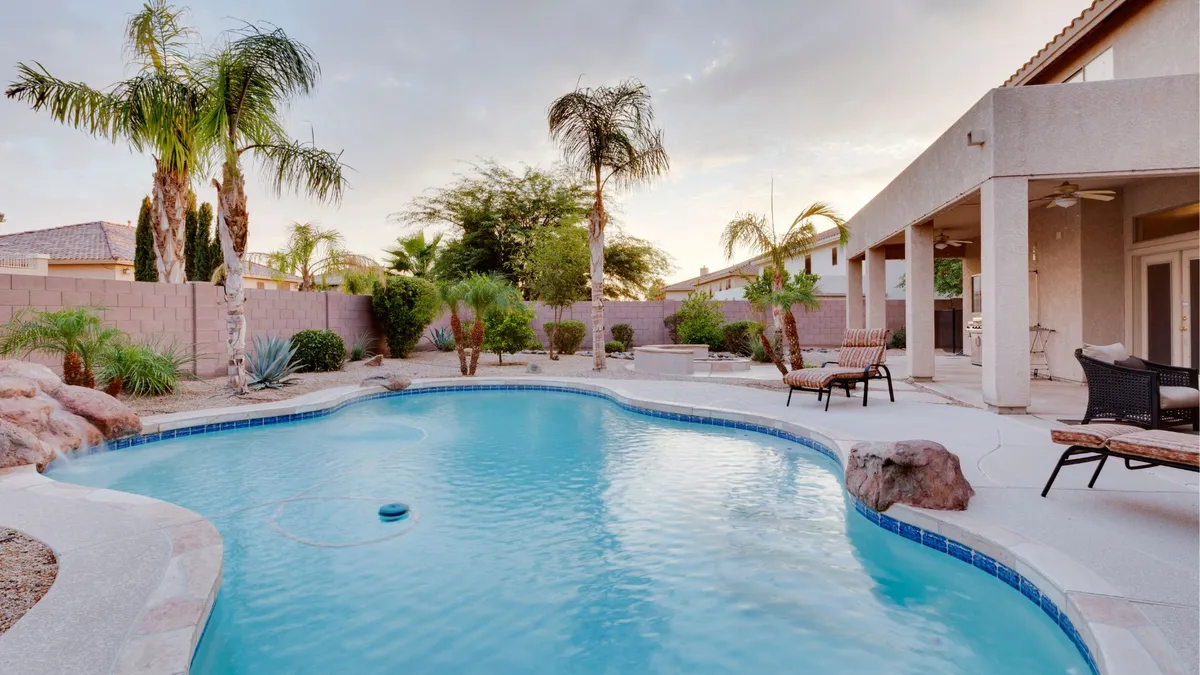
Transform Your Backyard into a Stunning Oasis with Our
Pool Repair and Construction Services
Revitalize your outdoor space with expert repairs that make your pool look brand new.
You deserve peace of mind knowing your pool repairs are handled by trusted experts.
Pool Equipment Check-Up 1 year maintenance Check-Up package to ensure long-term satisfaction.
Questions People Actually Ask
Why is my pool pump screeching so loud in the morning?
That squeal is the motor bearings drying out. Heat and blow-sand strip the grease, and it gets worse each week until the motor seizes. It still moves water while it screeches, so people wait. Waiting turns a motor swap into a full replacement.
My pump won't prime and the basket is full of air. What is wrong?
Air is getting in on the suction side, so the pump cannot pull a solid column of water. Check the water level, the lid o-ring, then the drain plugs. If those are fine, there is likely a leak in the buried suction line.
My pool pump keeps shutting off by itself after an hour. Is it broken?
That is the motor's own thermal overload protecting itself. It heats past its limit, cuts out, cools, and restarts. The cause is heat: a packed filter, a blocked fan shroud, direct sun, or bad bearings. The shutoff is a warning, not the fault.
How much does it cost to fix a pool heater in La Quinta?
Our diagnostic visit is $150, and it is credited toward the approved repair. The repair price depends on the part. You get a firm number before anything is ordered, and nothing happens without your okay.
How long does a pool heater last around here?
It depends on water balance, how much sand gets into the cabinet, and how hard the unit works. Hard water and blown-in debris are the two things that shorten heater life fastest in this valley. Good chemistry and a clean cabinet buy you years.
Can I clean the burner tray myself?
Please do not. Anything that involves opening the gas side of a heater is licensed work. If you want to help, keep the area around the heater clear, rinse dust off the cabinet, and keep your filter clean.
My spa says it is heating but the water stays cold. What is wrong?
Usually a valve actuator has stopped turning, so the heater is heating the pool instead of the spa. It is a small part and a short visit.
I have a heat pump, not a gas heater. Do you work on those?
Yes. Heat pumps fail differently, usually dirty coils, a fan motor, low refrigerant, or a sun-baked control board. Coils clog quickly here because of the fine dust.
My house sat empty all summer. Should I test the heater before I get back?
Yes, and this is the best thing a seasonal owner can do. Have someone run it two or three weeks before you arrive. October and November book out fast, so early testing gets you a real appointment instead of a wait.
Do you work on Raypak, Pentair, Jandy, and Hayward heaters?
Yes, we work on all four. Those are the brands we see most in this valley.
What should I have ready when I call?
Write down exactly what the panel says, note what the heater does when you switch it on, and know roughly how old it is. That short list often lets us bring the right part on the first trip.
Do you serve my part of La Quinta for pool heater repair?
We run heater calls along the Avenue 52 corridor, at homes off Eisenhower Drive, and through the Adams Street tracts, plus the rest of La Quinta. Our office is on Avenida Bermudas. Call (760) 619-2409.
Facebook
Instagram
LinkedIn
Youtube