
Licensed & Insured · Since 1998

Pool Heater Repair in La Quinta, CA

Proven Excellence
Our Passion is Transforming Your Backyard Vision into a Stunning Reality!
Next Door Neighborhood Favorite
Google and Yelp Reviews Below:
Why won't my pool heater turn on in La Quinta?
Go outside and stand next to your heater. Not across the yard. Right next to it. Then turn the heat on and just listen. Almost every pool heater repair in La Quinta starts with the same thirty seconds of sound, and you can learn a lot before anyone touches a screwdriver.
A healthy gas heater has a rhythm. First the fan spins up. You hear a low hum, like a small blower. Then a pause. Then a fast ticking sound, click-click-click, which is the igniter trying to make a spark. Then a soft whoosh as the burners catch. After that the tone changes to a steady low roar and stays there. That whole sequence takes maybe twenty to forty seconds.
Here are the three versions people describe to us on the phone.
Version one: nothing at all. You turn it on and the yard stays quiet. No fan, no click, no whoosh. That usually points at power or a safety switch, not the burners. Maybe the breaker tripped. Maybe the pump is not making enough flow and the water pressure switch never closes, so the heater never even tries. A heater is built to stay asleep until water is moving through it. Silence is often the heater protecting itself.
Version two: it clicks but nothing happens. Fan spins, ticking starts, ticking stops, silence. You get the spark but never the whoosh. That points at the fuel and ignition side. A worn igniter, a dirty flame sensor, a gas valve that is not opening, or a burner tray packed with blown-in sand.
Version three: it lights, then quits after a few minutes. You get the whoosh, you get the roar, you feel warm water, and then it goes quiet on its own. That is usually a heater that lights fine but cannot get rid of its own heat. Scale in the heat exchanger, weak flow, or a high-limit sensor doing its job.
None of those three are a guess about your wallet. They are just what the sound tells us, and they are where every honest pool heater repair in La Quinta should begin.
Most pool heater repair La Quinta calls come down to four things: no power or a tripped breaker, not enough water flow to close the pressure switch, a worn igniter or dirty flame sensor, or hard-water scale and blown-in sand choking the burners and heat exchanger. A licensed tech can tell which in one visit.
What hard water does to a heat exchanger
Our water is hard. It carries a lot of calcium. When that water runs through the narrow copper tubes inside a heat exchanger and gets hit with flame heat, some of the calcium drops out and sticks to the metal. Do that a few thousand times and you get a white, chalky crust inside the tubes.
That crust does two bad things. It shrinks the opening, so less water flows. And it acts like a blanket, so the copper cannot hand its heat off to the water. Now the flame is heating metal instead of your pool. The metal gets too hot. The high-limit safety trips. The heater shuts down.
That is why so many "it heats for ten minutes then quits" calls end up being scale, not electronics. Owners tell us they replaced a sensor and it did not help. Usually the sensor was fine. It was reading a real problem.
Scale also builds faster when your water balance drifts. High calcium plus high pH plus hot water is the recipe. Keeping your chemistry in range is the cheapest heater protection there is.
Sometimes a heat exchanger can be cleaned out. Sometimes it is too far gone and has to be replaced, and at that point the cost of the part starts to compete with the cost of a whole new heater. Scale is the single most common reason a pool heater repair in La Quinta turns into a bigger conversation, and we will tell you which side of that line you are on before you spend anything.
Swimming pool heater repair in La Quinta



Igniter. This is the part that makes the spark or the glow. It wears out. Heat cycles crack it. When it goes, you get the fan and the click and nothing else. It is a common part and a short job.
Flame sensor. After the burners light, this part has to confirm the flame is really there. If it is coated in soot or corrosion, the heater lights, then shuts itself off a second or two later because it thinks the flame failed. People describe this as "it lights and then panics."
Pressure switch. This is the safety that says water is moving. If your filter is dirty, a valve is half closed, or the pump is weak, the switch never closes and the heater never tries. We check the whole water path before we blame the switch itself, because a bad switch and a clogged filter look identical from the patio.
Gas valve. This opens to let fuel to the burners. When it fails, you get spark and no whoosh. Gas valve work is licensed work. It is not a weekend project.
Heat exchanger. This is the copper heart of the heater, where the flame heats your water. It is also the part hard valley water attacks. More on that below.
Burner tray. Out here this matters more than most places. Wind pushes fine sand and plant debris straight into the cabinet. Burners get partly blocked. Flames go uneven and yellow instead of blue. The heater runs poorly, sooty, and eventually stops.
We carry common igniters, sensors, and switches on the truck, so a lot of pool heater repair jobs finish the same visit. When a part has to be ordered, you get a firm price first. Nothing gets ordered until you say yes.
Gas heaters vs. heat pumps in the desert
A gas heater makes heat fast. You can go from cold to swim temperature in a few hours. That matters if you use the pool on weekends, or if guests come in and you want the water warm tonight. It also matters for spas, where nobody wants to wait until tomorrow.
A heat pump works differently. It does not burn anything. It pulls warmth out of the air and moves it into the water, like an air conditioner running backward. It is cheaper per degree, but it is slow, and it gets weaker as the night air gets colder. In our winter, when the daytime is beautiful and the overnight low drops hard, a heat pump can struggle to hold a temperature by itself.
Plenty of La Quinta homes end up with both: a heat pump to hold the pool at a steady number all season, and a gas heater for the spa or for a fast warm-up.
Heat pumps fail in their own ways. Dirty coils, a fan motor going bad, low refrigerant, or a control board that has been baking in the sun for years. Coils clog fast out here because of the fine dust. Rinsing them each season is one of the easiest things an owner can do.
We service both kinds. We work on Raypak, Pentair, Jandy, and Hayward equipment.
Swimming pool equipment repair
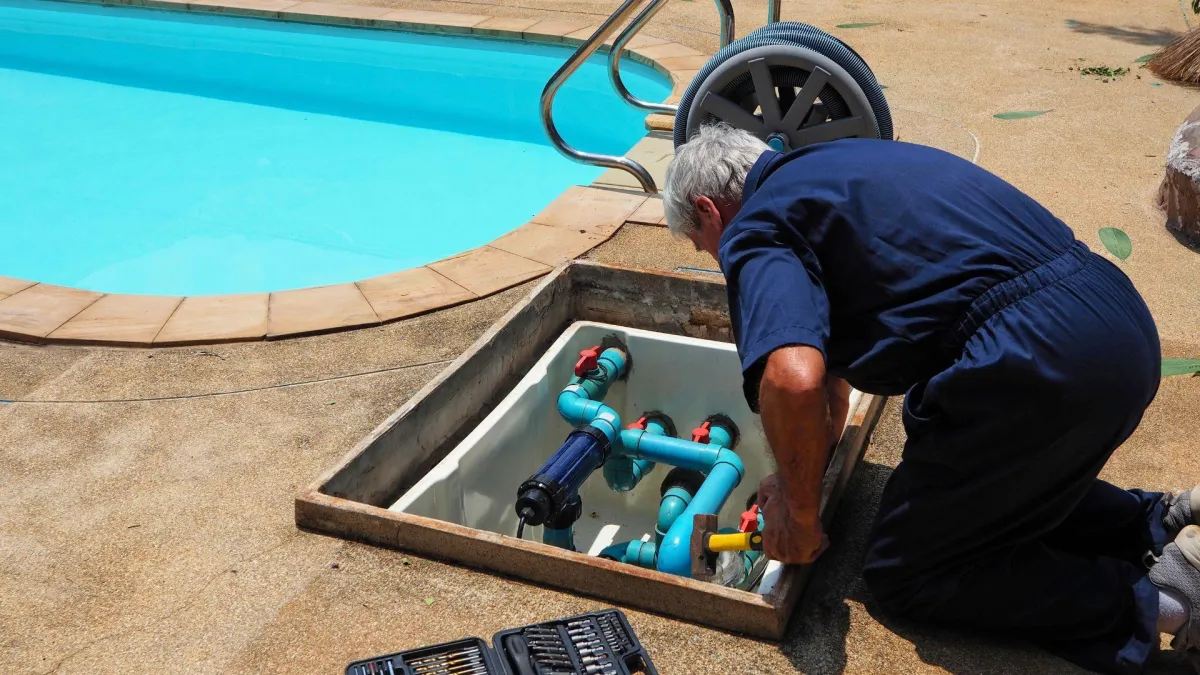
Your heater needs water, and the pump and filter are what deliver it. If the pump basket is packed, if the filter cartridges are gray and stiff, if a valve got bumped to half open, the heater sees weak flow and refuses to fire. We check the whole pad, not just the box you called about.
Common things we find alongside a heater problem:
A pump losing prime because of an air leak at the lid or a suction fitting
A filter that has not been cleaned in a long time and is choking flow
A variable-speed pump set to a low speed that is too slow to satisfy the heater
Old, brittle PVC around the pad that leaks whenever pressure comes up
A check valve stuck part way
Fixing those is not up selling. A new igniter in front of a starved pump will fail again, and you will be right back on the phone.
If your problem is really on the pump and filter side, that work lives on our pool equipment repair in La Quinta page. If you are not sure what broke, start with our main swimming pool repair service in La Quinta page and let us sort it out. We check the pad before we call a pool heater repair La Quinta job finished.
Electrical repair
A surprising number of "dead heater" calls are really power problems. More pool heater repair La Quinta visits end at the breaker than most owners expect.
Heaters need clean, steady power to run their controls. When power is missing or flaky, the panel goes dark and nothing happens at all. We check the breaker, the disconnect, the wiring at the pad, and the low-voltage connections between the heater and any automation system.
Out here the sun and the heat are hard on wiring. Insulation goes brittle. Conduit fittings crack. Wire nuts in a junction box corrode from moisture and chlorine in the air. On older pads we sometimes find splices that were never made for outdoor use.
Bonding is part of this too. Pool equipment has to be tied together with a bonding wire so that stray voltage has nowhere to go but ground. It is the single most important safety detail on an equipment pad, and it is the one we most often find broken, cut, or corroded away on older systems. Bonding and gas work are licensed work. Please do not try either yourself.
If the trouble turns out to be a controller or an app that will not talk to the heater, that is on our pool automation repair in La Quinta page. Straight wiring and bonding work is covered on our pool electrical repair in La Quinta page
Hot tub equipment repair
Spas are where cold water gets noticed fastest. Nobody eases into a 70-degree spa in January.
Attached spas usually share the heater with the pool, so a heater problem shows up in the spa first. We handle the valves, the actuators that switch between pool and spa mode, the blower, the jets, and the heater itself.
The classic call sounds like this: "It says spa mode, the jets come on, but the water never gets warm." Nine times out of ten a valve actuator has stopped turning, so the heater is happily heating the pool while the spa sits there. That is a small part and a short visit.
Standalone hot tubs have their own heaters, control packs, and pressure switches. Same story, smaller box, same pool heater repair La Quinta skill set.
More on spa work is on our hot tub repair in La Quinta page, and if you are thinking about rebuilding rather than repairing, see spa repair and construction in La Quinta.
When a heater is worth repairing and when it is worth replacing
Repair usually makes sense when the heater is under about ten years old, the cabinet and heat exchanger are solid, and the failed part is an igniter, a sensor, a switch, or a control board. Those are normal wear items. Replacing one is not throwing good money after bad.
Replacement starts to make sense when several of these are true at once:
The heat exchanger is scaled or leaking
The cabinet is rusted through at the bottom
Parts are getting hard to find for that model
You have already paid for two or three repairs in the last couple of seasons
The unit sat unused through several 115-degree summers and everything rubber inside has gone hard.
That last one catches a lot of second-home owners by surprise. A heater that never runs is not resting. It is baking. Gaskets dry out, rodents nest in the cabinet, and sand piles up in the burner tray. The first cold week of the season is when all of that shows up at once.
We give you the real number for the repair and the real number for the replacement, side by side, and then you choose. No pressure either way.
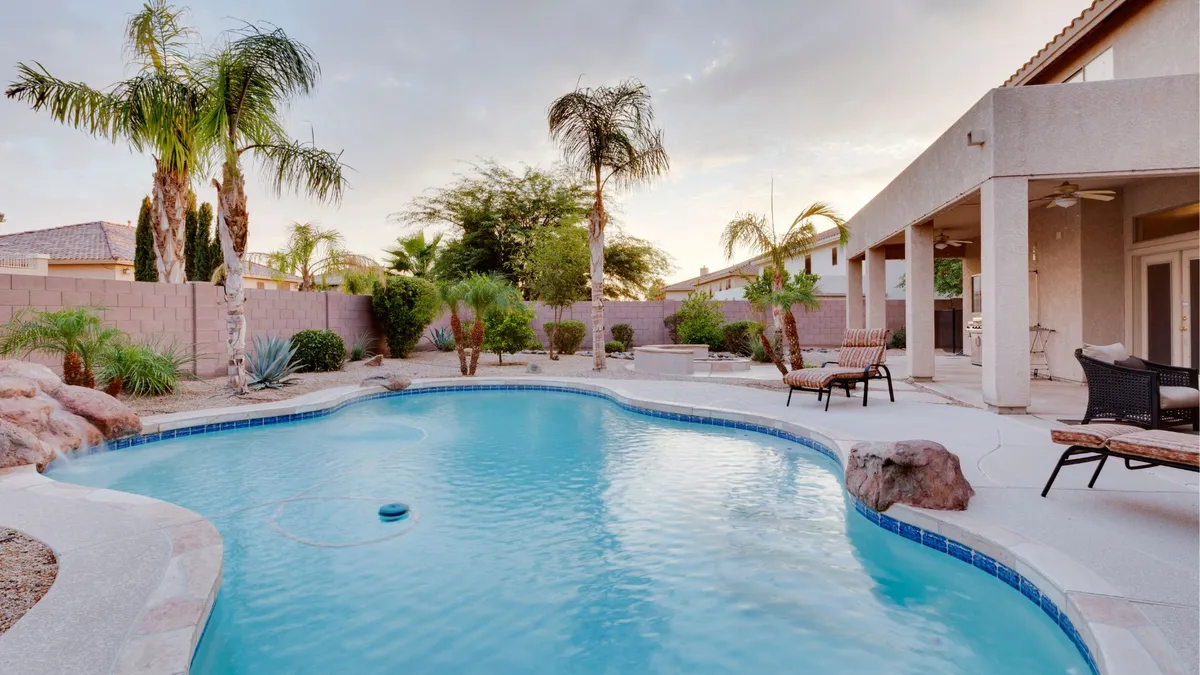
Transform Your Backyard into a Stunning Oasis with Our
Pool Repair and Construction Services
Revitalize your outdoor space with expert repairs that make your pool look brand new.
You deserve peace of mind knowing your pool repairs are handled by trusted experts.
Pool Equipment Check-Up 1 year maintenance Check-Up package to ensure long-term satisfaction.
Questions People Actually Ask
My pool heater clicks but nothing happens. What is that?
You are getting spark but no fuel catching. The usual causes are a worn igniter, a dirty flame sensor, a gas valve that is not opening, or sand and debris blocking the burner tray. It is a common failure and often a same-visit fix. Do not open the gas side yourself.
My heater runs for about ten minutes and then quits. Why?
That pattern almost always means the heater cannot shed its own heat. Scale from our hard water builds inside the heat exchanger, water flow drops, the metal gets too hot, and a safety shuts it down. Weak pump flow or a dirty filter can cause the same thing.
Nothing happens at all when I turn it on. No fan, no click.
Check your breaker first. If the breaker is on and the panel is still dark, you likely have a power problem, a failed control board, or a safety switch keeping the heater asleep because it does not see enough water flow.
How much does it cost to fix a pool heater in La Quinta?
Our diagnostic visit is $150, and it is credited toward the approved repair. The repair price depends on the part. You get a firm number before anything is ordered, and nothing happens without your okay.
How long does a pool heater last around here?
It depends on water balance, how much sand gets into the cabinet, and how hard the unit works. Hard water and blown-in debris are the two things that shorten heater life fastest in this valley. Good chemistry and a clean cabinet buy you years.
Can I clean the burner tray myself?
Please do not. Anything that involves opening the gas side of a heater is licensed work. If you want to help, keep the area around the heater clear, rinse dust off the cabinet, and keep your filter clean.
My spa says it is heating but the water stays cold. What is wrong?
Usually a valve actuator has stopped turning, so the heater is heating the pool instead of the spa. It is a small part and a short visit.
I have a heat pump, not a gas heater. Do you work on those?
Yes. Heat pumps fail differently, usually dirty coils, a fan motor, low refrigerant, or a sun-baked control board. Coils clog quickly here because of the fine dust.
My house sat empty all summer. Should I test the heater before I get back?
Yes, and this is the best thing a seasonal owner can do. Have someone run it two or three weeks before you arrive. October and November book out fast, so early testing gets you a real appointment instead of a wait.
Do you work on Raypak, Pentair, Jandy, and Hayward heaters?
Yes, we work on all four. Those are the brands we see most in this valley.
What should I have ready when I call?
Write down exactly what the panel says, note what the heater does when you switch it on, and know roughly how old it is. That short list often lets us bring the right part on the first trip.
Do you serve my part of La Quinta for pool heater repair?
We run heater calls along the Avenue 52 corridor, at homes off Eisenhower Drive, and through the Adams Street tracts, plus the rest of La Quinta. Our office is on Avenida Bermudas. Call (760) 619-2409.
Facebook
Instagram
LinkedIn
Youtube