
Licensed & Insured · Since 1998

Pool Equipment Repair in La Quinta: Let's Read Your Pad Before Anyone Sells You Anything

Proven Excellence
Our Passion is Transforming Your Backyard Vision into a Stunning Reality!
Next Door Neighborhood Favorite
Google and Yelp Reviews Below:
Start at the pad and read the labels
Walk out to your equipment pad and stand there for two minutes. That's the whole first step of good pool equipment repair in La Quinta. You don't need tools. You need your eyes and your phone light.
Look at the pump first. There's a metal or foil plate on the motor. It lists horsepower, service factor, voltage, and a model number. Somewhere on that plate or stamped into the housing is a date code. Sometimes it's plain, like 0407. That means April 2007. Sometimes it's a letter and two digits. Snap a photo of it.
Now the filter. Big label on the tank, usually facing the wall because whoever installed it wasn't thinking about you. Model, square footage, max pressure. Under that label, look at the clamp band and the o-ring seam for a chalky white ring. That's our water talking.
Heater next. Front panel, bottom right most of the time. Model, BTU rating, and a serial number that usually hides the build year in the first four digits. Then the salt cell, if you have one. The cell has its own label with a plate count and a date. And the timer or automation box on the wall has a sticker inside the door.
Five labels. Five ages. Line them up and you can almost tell the future.
Here's why. A pool built in the valley usually got all its gear on the same day. So if the pump says 2009, the filter and heater are probably 2009 too. Pumps in this heat give you eight to twelve years. Heaters, ten to fifteen. Filter tanks, longer. Salt cells, three to seven. When the pump dies at year eleven, the heater is not far behind.
That's not a scare tactic. That's a calendar.
Most people call us the day something stops. The water turns cloudy, or the pump screams, or the heater lights and then quits. They think they have one problem. The pad usually says otherwise.
A single failure on a twelve-year-old pad is rarely the last one. The motor bearings went, sure. But the same sun baked the union o-rings, the same hard water scaled the heat exchanger, and the same blow-sand chewed the cell gaskets. Fixing one part on a tired pad is fine. It's just good to know you did that, on purpose, instead of thinking you bought five more quiet years.
The opposite is also true, and it's the part we say more often. A six-year-old pad with one bad part is a repair, full stop. Nobody needs to replace a healthy filter because the pump quit. If a contractor walks up, glances at your pad, and quotes a full replacement without reading a single label, you learned something about that contractor.
We work as a swimming pool contractor in La Quinta on builds and remodels, so we could sell equipment all day. We'd rather fix what's fixable.
Read the date codes on your pump, filter, heater and salt cell. In La Quinta's heat and hard water, pumps last eight to twelve years, heaters ten to fifteen, salt cells three to seven, and filter tanks fifteen or more. Anything past those windows is living on borrowed time, even if it still runs today.
Two or three parts past their window at once is the point where repair math starts losing to replacement math. One part past its window is almost always a repair.
Swimming pool equipment repair



Swimming pool equipment repair, done properly, starts with the pad as a system. Water comes from the pool, through the skimmer and main drain, into the pump, through the filter, past the heater, through the salt cell, and back. One weak link changes the numbers everywhere downstream.
So we take readings before we take anything apart. Filter pressure at startup. Pump amp draw. Flow at the returns. Water temperature in and out of the heater. Voltage at the timer. Those five numbers tell us more than a customer's description ever can, and no offense meant by that. "It's making a noise" covers about forty different parts.
A visit runs $150 for the diagnostic. That gets you the readings, the pad age report from those labels, a clear answer on what failed and why, and a written repair price. If you approve the repair, the $150 comes right off the bill. If you don't, you still keep the report, and you're welcome to take it anywhere.
What we fix on a pad: pump motors, seals, impellers and baskets; filter tanks, laterals, grids, cartridges and manifolds; heater ignitors, pressure switches, gas valves and heat exchangers; salt cells, flow switches and control boards; actuators, valves, unions and plumbing; timers, relays, breakers and bonding.
Brands on valley pads are mostly Pentair, Hayward, Jandy and Raypak, and we service all of them.
One habit worth copying: write your clean filter pressure on the tank with a paint pen the day it's serviced. When it climbs eight to ten PSI over that number, the filter is telling you it's full. That single mark prevents a lot of panicked calls.
Browse all our swimming pool services in La Quinta if you're not sure which part of the pad your problem lives in.
Pump repairs & installation
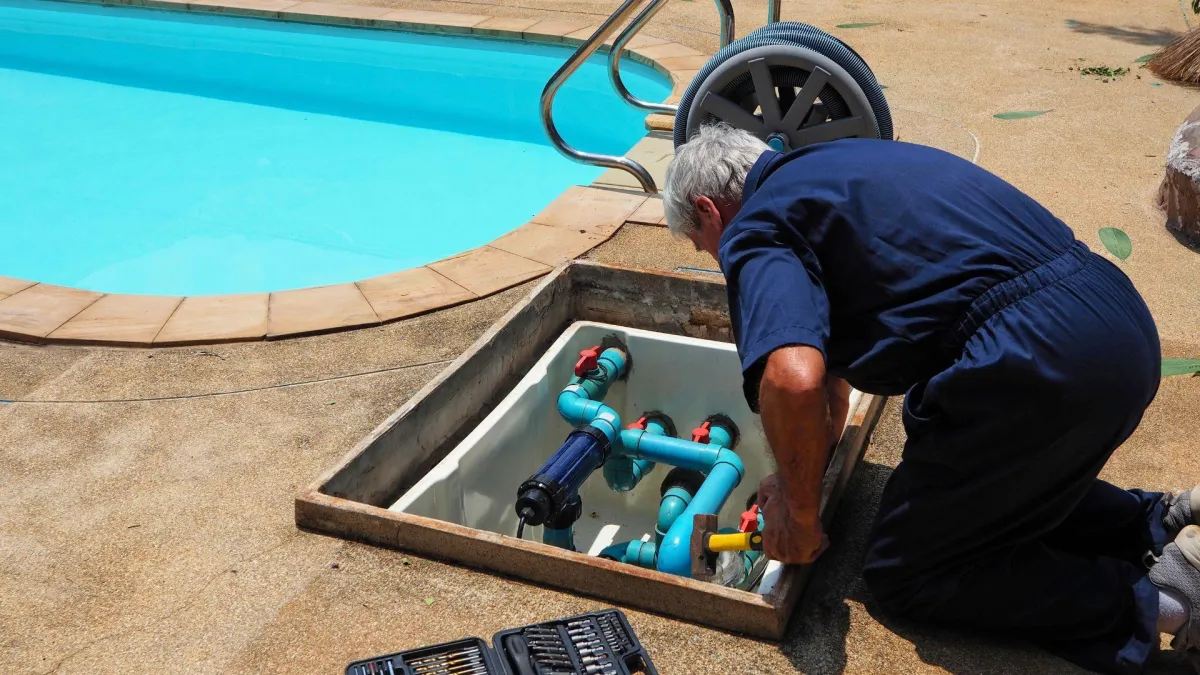
Pump repairs and installation is the busiest line on our board, and pool equipment repair in La Quinta almost always circles back to this box.
Here's the sound guide, because everybody describes it differently. A high whine that rises with the motor means bearings. A grinding rumble means bearings that waited too long. A wet spot under the pump with a rusty stain means the shaft seal let go and water has been running into the motor. Loud gurgling and a half-full basket means air, which is a suction-side leak, not a pump problem at all. Humming with no spin means the capacitor.
Bearings and seals and capacitors are repairs. A motor that tripped its thermal overload for the fifth time this month is not.
Now the part that surprises people. California Title 20 does not allow a new single-speed replacement pump above a certain size. If your 1998-era single-speed dies, it gets replaced with a variable-speed unit. That's the law, not an up sell.
Honestly, the variable-speed swap is the one equipment change we push, and only because the power bill math is silly. Old single-speeds run 3,450 RPM all day. A variable-speed does the same filtering at half the speed over a longer window and pulls a fraction of the watts
Sizing matters more than badge. Too big a pump on old 1.5-inch plumbing is loud, wasteful and hard on every seal downstream. We size to your actual pipe and your actual filter.
Deeper detail on motors, seals and speeds lives on our pool pump repair in La Quinta page.
Swimming pool filter repair
Swimming pool filter repair in the desert is its own animal. From July through September, monsoon wind drives fine blow-sand into everything. It packs cartridge pleats, buries DE grids, and loads sand beds until water starts channeling straight through.
Signs your filter is the problem: pressure eight to ten PSI above its clean reading, weak return flow, cloudy water that shrugs off chemicals, or DE powder blowing back into the pool.
That last one is a torn grid or a cracked manifold, and it's a repair, not a cleaning. Same with a cartridge that looks clean but feels stiff and shiny. Hard water calcium can seal the fabric closed so it filters almost nothing while looking brand new.
Cartridge filters: we pull, inspect and deep clean, and replace bad elements. DE filters: grids, manifolds, and the backwash valve spider gasket, which is the single most common leak on that style. Sand filters: laterals, media change, and multiport valve internals. Any filter: clamp bands, tank o-rings and pressure gauges, because a gauge reading wrong is worse than no gauge.
The calcium angle is real. Our water is hard, so scale builds at the tile line and it also builds inside tanks and on grids. A filter cleaned with plain water and never acid-soaked is only half cleaned.
Full detail on our pool filter repair in La Quinta page.
Electrical repair
Electrical repair on a pool pad is the part homeowners should leave alone. Not because it's mysterious. Because it's water, metal and 240 volts standing in the same three feet of concrete.
Common calls: the breaker trips every time the pump starts, the timer runs but nothing comes on, the light won't work, the GFCI keeps popping, or the whole pad is dead after a storm.
Most of those come down to a handful of things. Corroded lugs inside the subpanel. A mechanical timer with welded contacts. A relay that stopped closing. Rodent damage in conduit, which happens more than people expect out here. Or a bonding wire that rusted apart, which is both a code issue and a shock risk.
That bonding wire matters. CEC Article 680 requires all metal parts around the pool, including pumps, heaters, ladders and rebar, be bonded together with solid copper. Old pads lose that connection to corrosion, and nobody notices until someone feels a tingle on the handrail.
Storms are our other spike. Monsoon wind packs sand into cabinet vents and cooling slots, boards run hot, and hot boards fail weeks later. After a big blow, open your automation cabinet and look. If the inside is dusty brown, it needs cleaning before the next heat wave.
We work under license 994121 and back the work with 1 year warranty.
See pool electrical repair in La Quinta for panel, bonding and lighting work, or pool automation repair in La Quinta if the trouble is in the control system.
General repairs
General repairs is where the odd stuff lands, and the odd stuff is often what actually ruins your week.
Leaking unions and cracked PVC, because sun turns exposed pipe brittle in a decade. Valves that won't turn or won't seal. Actuators that hum and don't rotate. Skimmer weirs and baskets. Pad plumbing that was reworked twice by two different people and now has an air pocket nobody can bleed. Pressure-side and suction-side cleaner lines. Autofill valves stuck open, which is a quiet way to waste a lot of water when the pool already loses about a quarter inch a day to evaporation.
Heaters get their own note. Ours work hardest on cold December and January nights when the desert drops near freezing. A heater that ran fine in October and short-cycles in December usually has a scaled heat exchanger or a tired pressure switch. That's a pool heater repair in La Quinta call.
Salt systems scale for the same reason. Hard water plates over the cell, output falls, and the display starts complaining. Cells can be acid-cleaned a number of times before they're finished. Salt system repair in La Quinta covers cells, boards and flow switches.
If you're not sure what's broken, that's fine. That's literally the job. Our swimming pool repair service in La Quinta page covers the rest of the pool beyond the pad.
The pads we see around La Quinta
Our shop sits at 52115 Avenida Bermudas, so a lot of our pool equipment repair in La Quinta work happens within a short drive of the front door.
Around Avenida La Fonda, the homes and the courtyard pools are older, and the pads show it. Tight side yards, gear tucked against a block wall with barely any airflow, and a fair number of original single-speed pumps still turning at 3,450 RPM. Heat is the enemy there. A motor with no air around it runs hot and dies early, and sometimes the fix is as simple as clearing three feet of clearance and adding shade.
The Calle Estado blocks bring a different mix. More rentals, more short-term vacation stays, more pads that get hammered for a week then sit. Equipment actually prefers steady use. Long idle stretches dry out seals and let scale set.
Out along the Avenue 53 corridor, the lots are bigger and the systems are more complicated. Multiple pumps, spa spillovers, water features, heaters and automation all tied together. More parts, more failure points, and more reason to read the whole pad instead of one box.
One more thing specific to here: snowbirds and second homes sit empty May through October, which is exactly when the heat and the wind do their worst. If your place is closed for the season, have someone eyeball the pad.
HOA rules on screening and street-visible mounting vary block to block, and we'll match whatever yours requires.
If you've read this far, you probably already walked out and looked at the labels. Good. Send us those photos and you've done half the diagnostic before we arrive.
Here's how it goes. Call (760) 619-2409 or use our contact page for CV Pools in La Quinta. We're open Monday through Friday, 8:00 AM to 5:00 PM, out of 52115 Avenida Bermudas, La Quinta, CA 92253. The diagnostic visit is $150. We take the readings, age the pad, and hand you a written price. Approve the repair and that $150 comes off the total.
Estimates on remodels, re plaster, new builds and equipment upgrades are free. No diagnostic charge on those.
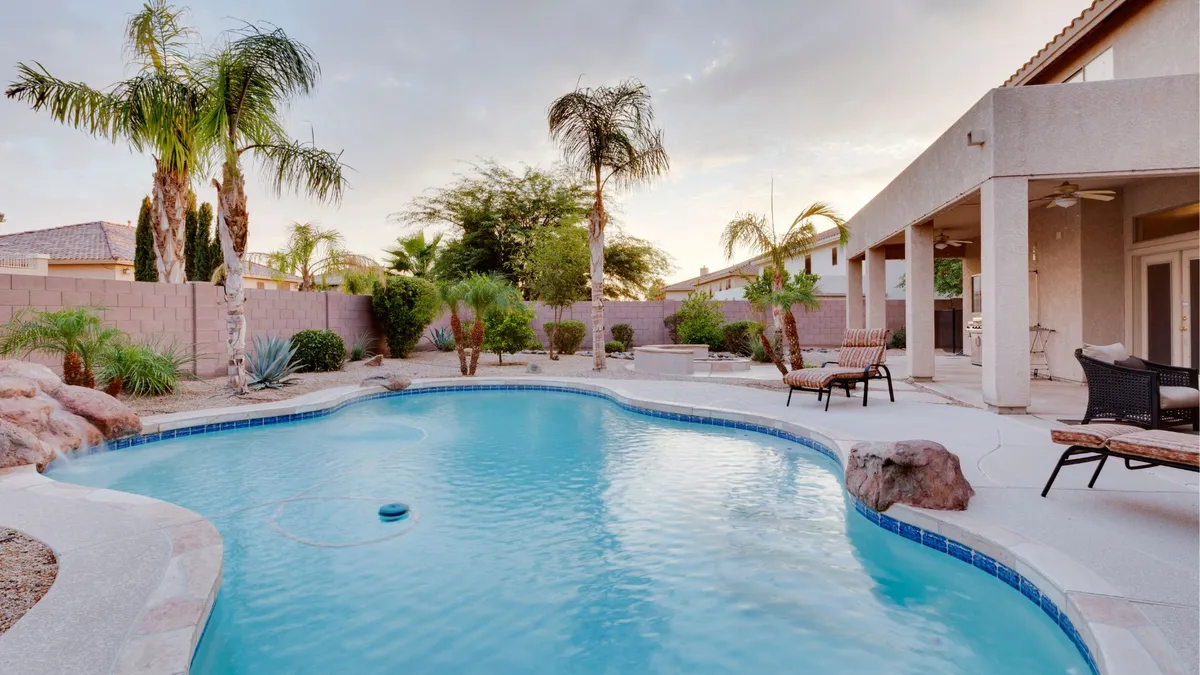
Transform Your Backyard into a Stunning Oasis with Our
Pool Repair and Construction Services
Revitalize your outdoor space with expert repairs that make your pool look brand new.
You deserve peace of mind knowing your pool repairs are handled by trusted experts.
Pool Equipment Check-Up 1 year maintenance Check-Up package to ensure long-term satisfaction.
Questions People Actually Ask
How do I know how old my pool equipment is?
Look for the date code on the motor plate, the heater serial number, and the label on the salt cell. Most valley pools got all their gear installed the same day, so one date usually tells you the age of everything
My pump is making a loud screaming noise. What is that?
Almost always bearings. A rising whine that tracks motor speed is the classic sign. It's a repair if you catch it early. If you run it until it grinds, you're buying a motor instead.
Can I just replace my old pump with the same kind?
Not in California. Title 20 rules require variable-speed for replacement pumps above a certain size, so a dead single-speed gets a variable-speed successor.
Why does my filter pressure keep climbing?
Because it's loading up. Monsoon blow-sand from July through September packs cartridges and DE grids fast here. When pressure sits eight to ten PSI over the clean reading, it needs service.
Is it cheaper to repair or replace pool equipment?
One part past its service life is almost always a repair. Two or three parts past their service life at once is where replacement starts winning, because you'll be paying separate service calls all year otherwise.
My pool house is closed for the summer. Should I worry about the equipment?
Yes. May through October is the hardest stretch on a pad, and that's exactly when second homes sit empty. Heat, wind and scale don't take the season off. Have someone check it.
Do you charge for estimates?
Repairs get the $150 diagnostic, credited to the work. Remodels, replaster, new builds and equipment upgrades get free estimates.
Facebook
Instagram
LinkedIn
Youtube