
Licensed & Insured · Since 1998

Pool Leak Detection in La Quinta, CA

Proven Excellence
Our Passion is Transforming Your Backyard Vision into a Stunning Reality!
Next Door Neighborhood Favorite
Google and Yelp Reviews Below:
The Bucket Test You Can Do Tonight
Pool leak detection La Quinta homeowners can start on their own, right in the backyard, before anybody gets called. You need a five-gallon bucket, a permanent marker, and twenty-four hours. That's it.
Here is how to do it.
Fill the bucket about three-quarters full with pool water. Set it on your top step, the shallow one, so the bucket sits down in the water. Do not set it on the deck. It has to sit in the pool so both bodies of water feel the same sun and the same heat.
Now mark two lines. Mark the water level inside the bucket. Mark the water level outside the bucket, on the same wall, where the pool touches it. Two marks, one bucket.
Then leave it alone. Turn the pump off, or leave it on your normal schedule, but pick one and keep it the same for the whole day. Shut off the auto-fill if you have one. Keep the kids and the dog out of the pool. No splashing, no cannonballs, no backwashing the filter.
Come back in twenty-four hours and look at both lines.
If the water dropped about the same amount inside the bucket and outside it, your pool is not leaking. That's the desert doing what the desert does. In a Coachella Valley summer, roughly a quarter inch a day is the rule of thumb people use for normal evaporation. Hot air, dry air, and wind pull water off the surface all day long. Nothing is broken. You can stop worrying, and you just saved yourself a service call.
If the pool dropped noticeably more than the bucket, you have a leak. The bucket is your control. Same sun, same heat, same day. The only thing the pool has that the bucket doesn't is plumbing, a shell, fittings, and maybe a spa.
That's where the free part ends. The bucket tells you whether. It cannot tell you where. Finding where takes pressure gauges, listening equipment, dye, and a license. Guessing at that part is how people end up with a saw cut in the wrong spot.
Talk to us about your pool leak once you know your two lines don't match.
Is my pool leaking or is it just evaporation?
Run a bucket test. Float a marked bucket on the top step for 24 hours with the auto-fill off. If the pool and the bucket drop the same, it's evaporation in a desert summer about a quarter inch a day is the usual rule of thumb. If the pool drops more, you have a leak.
What A Leak Looks Like From The Yard
Most people don't call us because they measured something. They call because something looked off.
Here's what our customers actually say, and what it usually means.
There's a wet spot that never dries." In July, in this valley, nothing stays wet. If one patch of dirt or one seam of deck is damp at noon in August, water is coming from under it, not from above it.
One part of the deck is sinking. Water moving through soil takes the fine dirt with it. The ground gives up a little, and the deck follows. Our soil already moves with heat and with irrigation. Add a slow line leak and it moves faster.
There's a green stripe in my yard. Grass and shrubs along a straight line, greener than everything beside them, is usually a plumbing run getting watered by accident. Plants find the leak before people do.
The pump keeps losing prime. Air in the pump basket, a spitting return, a pump that stops pulling — that's the suction side. The pool may barely drop at all, because the leak is pulling air in, not pushing water out.
I keep filling it. The most common one of all. The hose lives by the pool now, and the level still isn't right by Friday.
Any of those is reason enough to get real pool leak detection La Quinta crews can back up with a test, not a hunch.
Swimming pool leak detection & repairs



We've been doing pool leak detection La Quinta side of the valley since 1998, and the method hasn't changed much, because it works.
We start with the usual suspects, since those are the parts that fail most. Skimmer throats crack where the plastic meets the concrete. Return fittings loosen and let water run behind the shell. Main drains and their plugs give up their seals. Light niches leak at the conduit. Spa spillways crack right at the lip, and a spa can quietly drain itself into the wall.
Next we isolate. Plugs go in, sections come off line, and we watch which section keeps losing water and which one holds. That alone cuts the search area down hard.
Then we pressure test the lines. One line at a time goes under gauge, and we watch whether the needle holds. A line that holds is not your problem. A line that drops is, and now it's pinned down. This is the step people skip when they guess, and guessing at the deck gets expensive fast.
Then listening equipment. A leak under concrete makes noise. We track that noise across the deck and mark the spot. At suspected surface points we use dye and watch which way the water pulls it.
Only then do we talk about opening anything. Cutting deck is the last step, not the first. By the time a saw comes out, the line, the depth, and roughly the foot of pipe are already marked. Repair pricing depends on what we find and how deep it sits see
Every one of those repairs is our own crew, so the person who found it is the person who fixes it. The full list of what we handle is on our swimming pool repair service in La Quinta page.
Swimming pool general plumbing repairs
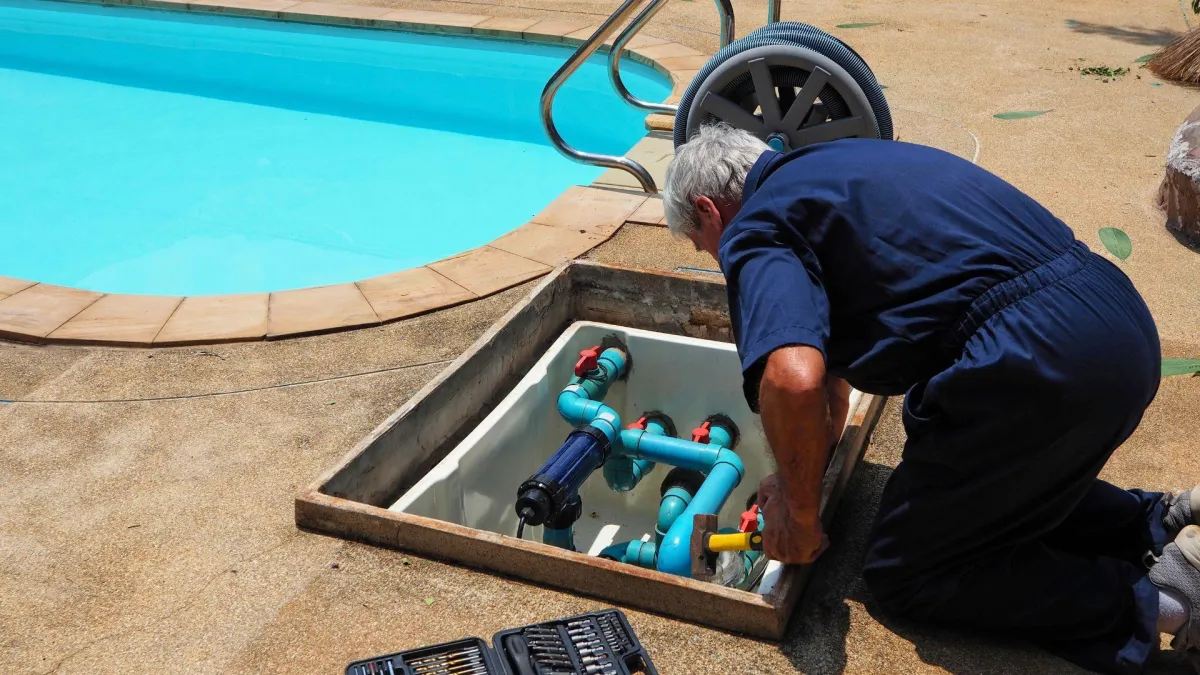
Pool plumbing lives underground in soil that heats, cools, and shifts. Twenty-five years of that adds up. Glue joints tire out. Fittings crack at the shoulder. A line that was fine for two decades starts weeping at one elbow.
There are two sides, and they behave differently.
Suction side pulls water toward the pump. Skimmer lines and main drain lines. A suction leak often shows up as air, not water: bubbles in the pump basket, a pump that loses prime, a return that sputters. You may lose almost no water and still have a real problem.
Pressure side pushes water back out to the returns and the spa. A pressure leak dumps water while the pump runs, and usually slows way down when it shuts off. If your pool drops fast during run hours and barely moves overnight, that points here.
That difference matters, because it tells us where to test first. It's why we always ask when the water goes — all day, or only while the equipment runs.
Repairs run from cutting out one bad fitting to rerouting a whole line. On some homes, rerouting above ground through a planter beats tearing out twenty feet of deck. We'll tell you straight which one makes sense on your property.
One more thing on plumbing work. If we have to pull a pool light to test a niche, or open a section near light conduit, the electrical side has its own rules. Pool light and niche wiring falls under California Electrical Code Article 680, and the bonding has to go back exactly the way it came out.
Before publish: verify this code reference against current code.
More on lines, valves, and fittings on our pool plumbing repair in La Quinta page.
Swimming pool crack repair
Not every crack leaks. A hairline in plaster is usually cosmetic. A structural crack in the gunite behind it is a different animal, and it will keep taking water until it's fixed right.
Out here, cracks come from movement. Soil expands and contracts. Irrigation soaks one side of the yard and not the other. A pool built on cut-and-fill sits on two different kinds of ground. Over years, something has to give.
We look for the tell-tales: a crack that runs through tile and plaster in the same line, staining that follows the crack, a step or bench pulling away from the wall, or a spa wall separating at the bench.
Dye tells us whether it's actually taking water. If it is, the repair is not caulk. It's a proper structural repair — staples and epoxy where the crack calls for it — and then the surface goes back over the top. Anything less and you're back here in a year.
Cracks at the spillway and around light niches are their own category, because they sit where two materials meet. Those are common leak points and easy to miss from a patio chair.
If a repair means cutting deck, or pulling a section of fence or a gate to get equipment in, the pool barrier has to be whole again before we leave the property. California pool barrier rules apply, HOAs enforce their own version, and neither one bends for an open work site.
Before publish: verify this code reference against current code.
Details and options are on our pool crack repair in La Quinta page. Estimates on replaster and remodel work are free if the fix turns into a resurface.
Swimming pool auto water fill repair
This is the one that costs people the most money, and almost nobody sees it coming.
An auto-fill valve is a small float in a box on your deck. When the level drops, it opens a city water line and tops the pool off. Handy. Also the single best way to hide a leak.
Here's how it goes wrong. The pool starts losing water. The auto-fill quietly replaces it. The level looks perfect. Nobody notices anything for months. The leak keeps working on the soil under the deck the whole time, and the only place it shows up is the water bill.
We hear this every spring from second-home owners. The house sat empty from May to October. Nobody looked at the pool. The valve did its job all summer long, and the first sign of trouble was a bill, a sunken deck, or a bill and a sunken deck.
Auto-fill valves also fail on their own. The float sticks open and the pool runs over the coping. Or minerals from our hard water crust the valve shut, and the fill quits working the week you need it most.
That valve is the single biggest thing that complicates pool leak detection La Quinta homeowners ask us for. So two things we tell every owner. One: shut the auto-fill off before you run a bucket test, or the test means nothing at all. Two: if you leave for the season, have someone check the pool, not just glance at the level.
Repair and replacement work is on our auto water fill repair in La Quinta page.
When The Leak Shows Up As A Bill
A pool leak doesn't always look like a low pool. On a house with an auto-fill, it looks like a water bill that doubled for no reason anybody can name.
If your bill jumped and your landscaping didn't change, do this. Shut the auto-fill valve off for one day and run the bucket test. If the pool falls behind the bucket, the pool is where your water went.
There's another version we see a lot: the equipment pad. A weeping pump seal, a leaking filter clamp, or a cracked valve body drips all day while the system runs. That water hits warm concrete and evaporates, so there's no puddle by morning and nobody catches it. Look at the pad in the first hour of run time, not at noon.
Anything at the pad pumps, filters, heaters, valves is covered on our pool equipment repair in La Quinta page. If you're not sure yet what you're dealing with, start with general pool repair in La Quinta and we'll sort it out from there.
Water in this valley is hard and it is not cheap. A slow leak running all season is real money before it ever becomes a repair. That's the honest case for pool leak detection La Quinta owners keep putting off.
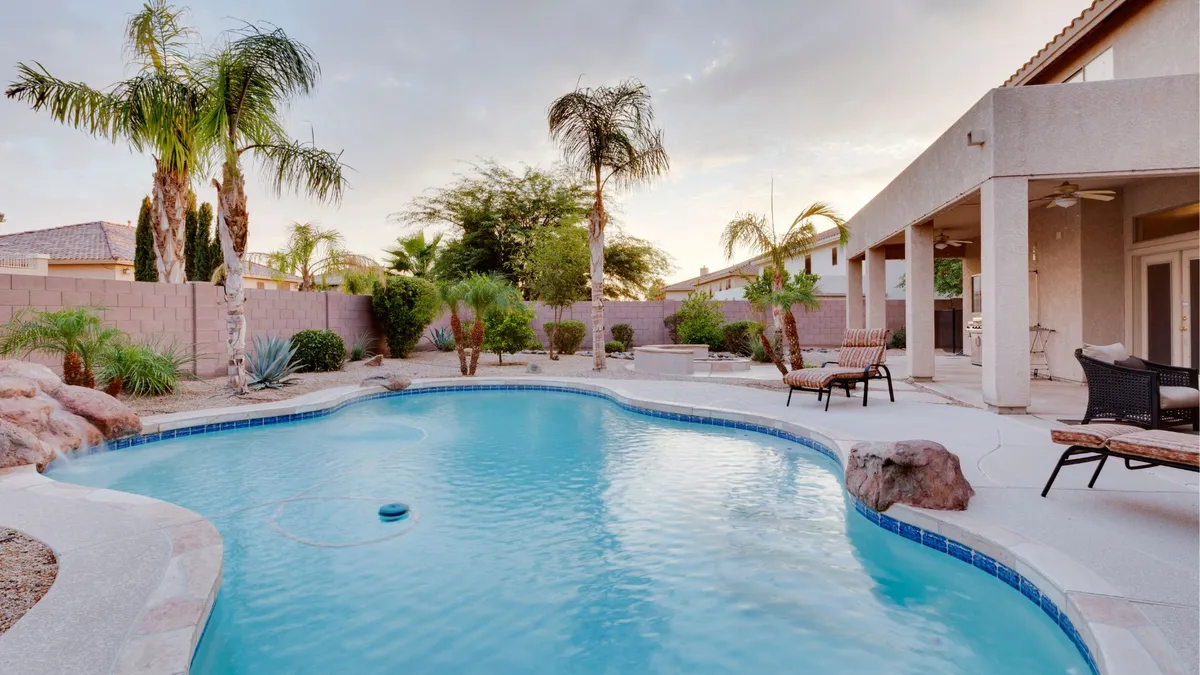
Transform Your Backyard into a Stunning Oasis with Our
Pool Repair and Construction Services
Revitalize your outdoor space with expert repairs that make your pool look brand new.
You deserve peace of mind knowing your pool repairs are handled by trusted experts.
Pool Equipment Check-Up 1 year maintenance Check-Up package to ensure long-term satisfaction.
Questions People Actually Ask
How much water loss is normal for a pool in La Quinta?
In a desert summer, the rule of thumb people use is about a quarter inch a day from evaporation. That's a guideline, not a measurement wind, humidity, and whether your pool sits in sun all day all change it. The bucket test is the honest way to check your own pool.
My pool is dropping an inch a day. Is that a leak?
Almost certainly, yes. That's well past what evaporation explains in this valley. Run the bucket test to confirm, shut your auto-fill off while you do it, then call us.
Does the pump need to be on or off for the bucket test?
Either, as long as you keep it the same for the full 24 hours. Running it both ways over two days actually tells us more. If the pool loses more with the pump running, that points at pressure-side plumbing. If it loses the same either way, that points at the shell..
The water's gone down but I don't see anything wet. Where is it going?
Into the ground, usually. Our soil drinks it and the surface dries in an hour. That's why we test lines instead of hunting for puddles.
I keep filling it and it never stays. Can you just find it?
That's exactly what the $150 diagnostic is for. We isolate the sections, pressure test the lines, and tell you where it is. That $150 comes off the repair when you approve it.
Do you have to break my deck to find the leak?
No. Finding it doesn't require cutting anything. We test and listen first. Cutting only happens after the line and the spot are pinned down, and only to fix it never to look for it.
Can a pool leak crack my deck or shift my patio?
It can. Water moving under a slab carries fine soil with it, and the slab settles into the space left behind. That's why a sinking corner or a new seam in the deck is worth a look, even if the pool level seems fine.
My water bill went way up but the pool looks full. What's going on?
That's usually an auto-fill valve covering for a leak. The valve keeps topping the pool off, so the level looks perfect while the meter runs. Shut the valve off for a day and run the bucket test.
We're only here in the winter. How do we catch a leak while we're gone?
Have someone actually look at the pool, not just glance at the level. On an empty house the auto-fill can hide a leak all summer. A quick check of the pad, the deck, and the meter once a month catches most of it.
Is a crack in my plaster a leak?
Not always. Hairline plaster cracks are often cosmetic. A crack that runs through the tile line and the plaster together, or one with staining following it, is the kind we test with dye.
Do you fix what you find, or do I have to hire someone else?
We fix it. Same company, same crew. Plumbing, cracks, auto-fills, equipment it's all in house
How fast can someone come out?
We're open Monday through Friday, 6:00 AM to 9:00 PM. Call (760) 619-2409 and we'll get you on the schedule. Our current turnaround in La Quinta
Facebook
Instagram
LinkedIn
Youtube