
Licensed & Insured · Since 1998

Pool Filter Repair La Quinta Homeowners Call When The Gauge Climbs

Proven Excellence
Our Passion is Transforming Your Backyard Vision into a Stunning Reality!
Next Door Neighborhood Favorite
Google and Yelp Reviews Below:
Why is my pool filter pressure high?
Here is a free job that takes thirty seconds and will save you money for years, and most people who search for pool filter repair La Quinta wide have never been told to do it. Go out to your equipment pad. Find the round pressure gauge on top of the filter tank. Grab a permanent marker. The next time that filter is actually clean the day after a service, or right after you rinse the cartridges read the gauge with the pump running and write that number on the tank. Put the date next to it.
That number is your baseline. Nobody else's number works, because a clean reading depends on your pump, your plumbing, and how high the pad sits. One pool reads 9 pounds clean. The one next door reads 18. Both are fine.
Once that number is on the tank, the gauge turns into a distance. You are not asking "is 24 high?" You are asking "how far above clean am I?" Roughly eight to ten pounds over clean means the filter is full and asking for service.
Now flip it. Pressure going down below the clean number is the message almost everybody misses. That is usually not a cleaner filter. That is something upstream starving the pump air, a clogged basket, a closed valve, a low water level.
In this valley the gauge moves faster than almost anywhere. Here is why.
High filter pressure almost always means the filter media is loaded and water cannot pass through it easily. Dirt, sunscreen oil, fine desert silt, algae, and calcium dust pack into the pleats, grids, or sand bed. The pump pushes the same water against more resistance, so the gauge climbs. Around eight to ten pounds above your clean reading, it needs cleaning or repair. If cleaning does not drop it, something inside the tank has failed.
How often should a filter really be cleaned here?
For most La Quinta pools, plan on a deep clean two to four times a year, and let the gauge not the calendar call the date. Heavy swimmer load, a monsoon month, or a pad on the open desert edge pushes you to the high end. A sheltered yard with light use lands at the low end.
Empty houses are their own case. A snowbird pool that sits all summer still runs a pump, still evaporates a quarter inch a day, and still catches every wind event with nobody watching the gauge. A caretaker should photograph the gauge weekly, keep the water at mid-tile so the pump never starves, empty baskets, and call for a deep clean after any real wind event instead of waiting for an October return date.
Water chemistry drives filter life too hard water leaves calcium dust that cements into media so a pool water analysis in La Quinta is worth pairing with the first clean.
Repair it, replace it, or size it up?
Pool filter repair in La Quinta comes down to three outcomes.
Replace when the body is cracked, when the tank is old enough that parts are gone, or when new elements cost close to a new filter.
Here is the one nobody says out loud: a lot of valley pools were built with a filter barely big enough on the day it went in. It passed, and it was cheap. In a sand climate an undersized filter means constant service forever.
If your gauge climbs eight pounds within three weeks of every clean, the filter is probably not failing. It is too small. Sizing up is the real fix, and it often costs less over two years than the cleanings it replaces
Swimming pool equipment repair in La Quinta



When the filter chokes, flow drops. The pump does not get lazy it works harder against the restriction, runs hotter, and pushes its bearings and seal harder in 115-degree ambient air. That is how a dirty tank quietly ends a motor. If yours is whining already, start at pool pump repair in La Quinta.
Heaters are stricter. A heater watches flow, and below its minimum it will not fire at all. Homeowners think the heater died. Half the time the heater is fine and the filter is full. Pool heater repair in La Quinta starts with the same gauge reading.
Salt systems tell the same story a different way. Low flow through the cell drops chlorine output and the panel throws a low-flow or low-output message. Salt system repair in La Quinta usually begins by clearing what is upstream.
Pool filter repair in La Quinta is the cheapest protection for the expensive gear on the pad. Full-pad work is on the pool equipment repair in La Quinta page.
The pump is the piece that pays for a neglected filter first.
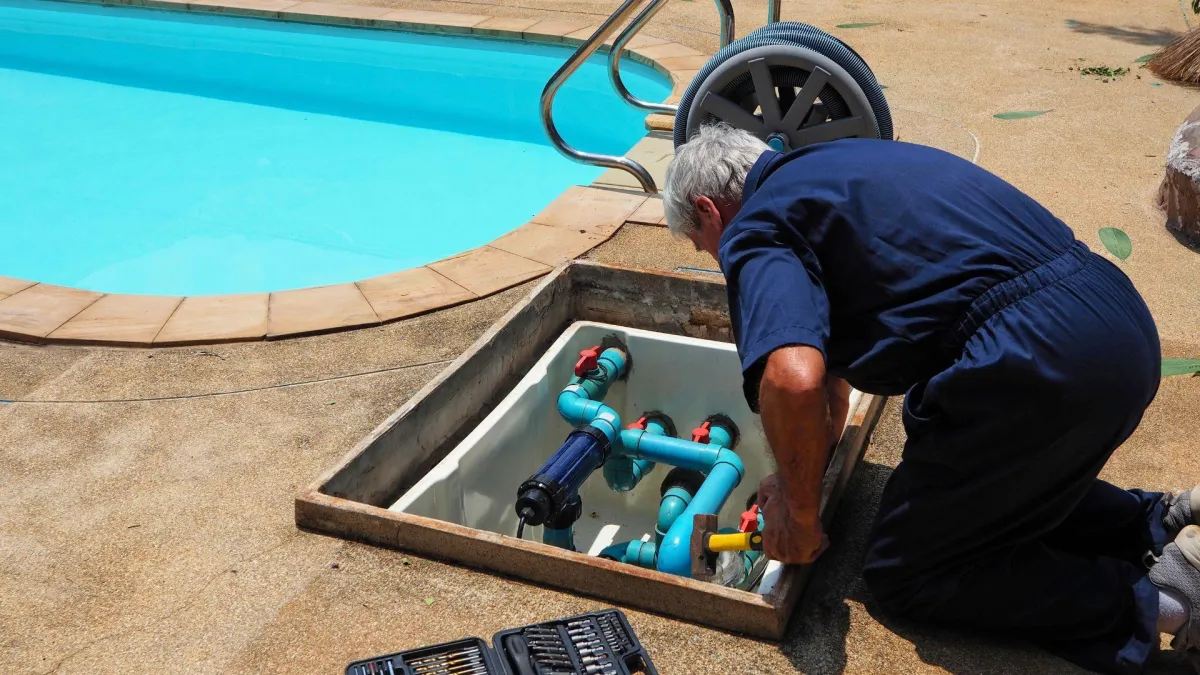
Pump repairs & installation
Pump repairs & installation come up on filter calls more than any other trade. If the filter has been loaded for a season, the shaft seal, motor bearings, lid o-ring, and basket all get checked. On a 1998-era single-speed still spinning at 3,450 RPM, a filter upgrade and a variable-speed pump usually get quoted together: the slower pump moves water gently and the bigger tank holds more dirt. That pairing cuts run noise too, which matters under HOA equipment-noise rules. [[BRAND_CERTS]] covers the Pentair, Hayward, Jandy, and Sta-Rite gear on most valley pads.
A leak on the pad is rarely just one fitting, and it is worth being straight about that.
Swimming pool general plumbing repairs
Swimming pool general plumbing repairs handle what happens around the tank. Water running from under a band clamp is usually a tank o-ring or a clamp that lost its seal, and both are fixable. Water at the base is different that can be a cracked bulkhead or a split body. Old PVC goes brittle in this sun, so unions crack, multiport valve spiders wear out and leak past to waste, and backwash lines split. Fittings baked for twenty years often break while being loosened, which is normal and gets replaced the same visit. More at pool plumbing repair in La Quinta.
Some jobs are smaller than that, and those matter too.
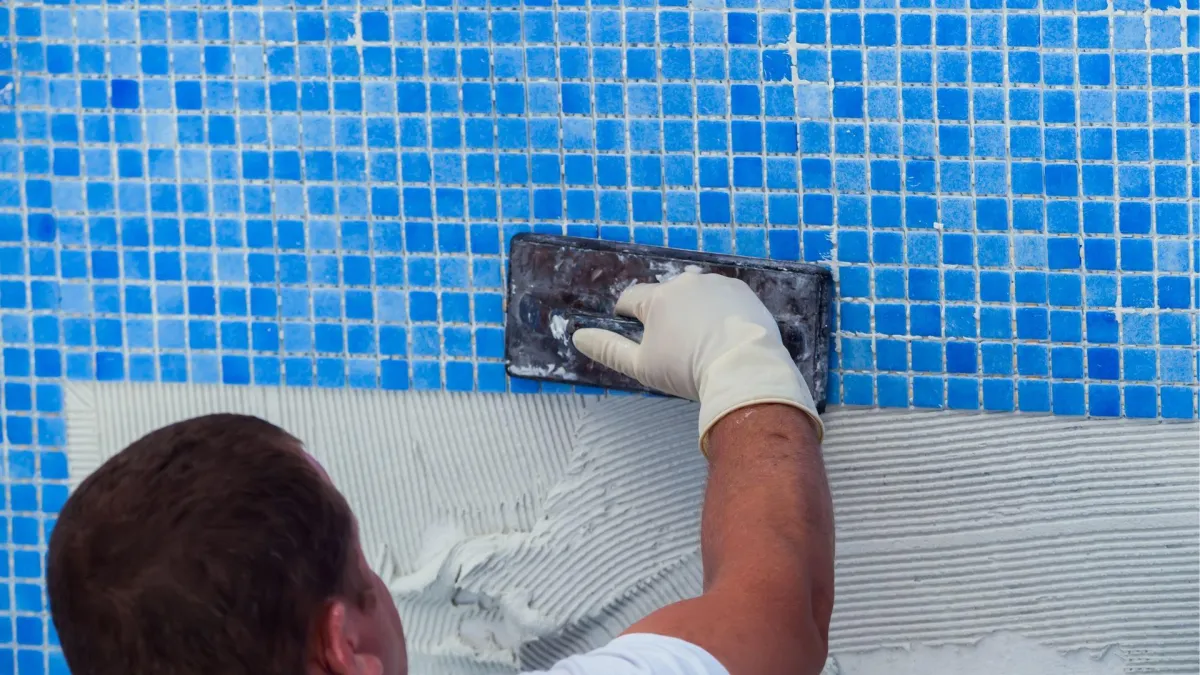
General repairs
General repairs are the small items found while the tank is open a dead pressure gauge, a stuck air relief valve, a missing lid clamp, a sun-eaten drain plug, a pressure switch out of calibration. None are dramatic. All of them change what the pad does. A gauge stuck at 12 forever is worse than no gauge, because it convinces a homeowner nothing is wrong for a whole season.
What monsoon blow-sand does to a filter here
July through September, one afternoon of wind can do what a normal month of swimming cannot. This surprises people who moved here from somewhere green.
Leaves and blossoms are big. They land on top of the media and sit there, and a rinse takes the pressure right back down. Fine silica dust does not behave that way. It is small enough to travel into the pleat, into the DE fabric, into the sand bed, and then it packs. Rinse the outside of a cartridge and it looks brand new surface clean, color back and the gauge climbs again within two days, because the load never left the pleat.
That is why a filter that "was just cleaned" can be at service pressure by the weekend after a blow. It also explains a strange call that comes in every August: the water is clear and the filter is choked anyway. Clear water and a loaded filter are not opposites here.
The three patterns are different jobs. Homes on the Monroe Street corridor sit closest to open ground and take the worst of the raw blow-sand those pads get a full load in one wind event. The Fred Waring Drive tracts have older mature landscaping, so it is a leaf, seed pod, and blossom load: heavier in volume, easier to rinse off, but murder on the pump basket in spring. Homes along the Highway 111 corridor get something quieter and constant, fine road grit and brake dust that never stops, with no dramatic wind event just a filter always a little dirtier than it should be.
After a real wind event, deep-clean the elements instead of rinsing them. A soak breaks loose what a hose only rearranges.
Filters do not fail alone, which is the part that costs real money.
Cartridge, DE and sand: which one belongs on a desert pool?
Nobody wins this argument outright, so here is the trade-off.
Cartridge catches down to roughly 10–15 microns and uses almost no water to service. That matters here, because drought restrictions come and go in the Coachella Valley and a cartridge tank never backwashes you pull the elements and rinse them. The downside is labor, and elements wear out and get replaced.
DE filters the finest of the three, near 3–5 microns, so the water looks glassy. It costs water every backwash and a recharge of powder afterward. Grids tear. There is more to go wrong.
Sand is the toughest and simplest, but filters the coarsest roughly 20–40 microns — and it is the one blowing desert silt punishes hardest, because a lot of that fine material passes through the bed and comes back to the pool. Every backwash also runs several hundred gallons down the drain.
There is no universal winner. What matters more than type is size. A big cartridge tank on a small pool will outlast a slightly-too-small DE tank every summer. Get the square footage right first, then argue about media.
And now the season that decides most of it.
Transform Your Backyard into a Stunning Oasis with Our
Pool Repair and Construction Services
Revitalize your outdoor space with expert repairs that make your pool look brand new.
You deserve peace of mind knowing your pool repairs are handled by trusted experts.
Pool Equipment Check-Up 1 year maintenance Check-Up package to ensure long-term satisfaction.
Questions People Actually Ask
How do I know when my pool filter needs cleaning?
Compare today's gauge reading to your clean baseline. Eight to ten pounds above clean means it is time. Without a baseline you are only guessing, so write the clean number on the tank in marker. Weak returns or a heater that will not fire say the same thing.
How often do filters need cleaning in the desert?
Two to four deep cleans a year for most La Quinta pools, plus one after any serious monsoon wind event. Pads on the open desert edge run at the high end. Sheltered yards with light use run at the low end. Let the gauge set the date.
Can I clean my own cartridges, and how do I avoid wrecking them?
Yes, most people can. Turn the pump off, bleed the air relief valve, then open the tank. Rinse each pleat top to bottom with a regular hose nozzle held at an angle. Never use a pressure washer. It drives grit into the fabric and cuts the pleats.
Does hosing them off actually count as cleaning?
It counts for surface dirt only. It does not touch the fine silica dust here, which packs inside the pleat where a hose cannot reach. That is why a rinsed cartridge looks new and the pressure climbs back in two days. A few times a year the elements need an overnight soak.
When do cartridges need replacing instead of cleaning?
When the pleats stay gray after a soak, when the fabric feels stiff, when pleats are torn or end caps are loose, or when the clean baseline pressure creeps up year over year. Most elements last a few seasons here. Calcium and sun shorten that.
My filter pressure went DOWN, not up. What does that mean?
That is a flow problem upstream, not a cleaner filter. Check the water level, the skimmer and pump baskets, the pump lid o-ring for a sucked-in air leak, and valve positions. Low pressure with a loud pump means the pump is starving, and that damages the seal.
Water is coming out around the middle of the tank. Is that bad?
The seal at the band clamp has let go a flattened tank o-ring, a loose clamp, or debris on the sealing surface. Shut the pump off. Do not tighten a clamp under pressure. Most of these are a part and gasket repair, not a new filter.
Do I have to backwash, and how much water does it use?
Only sand and DE filters backwash. One backwash sends several hundred gallons to the drain, which adds up fast during drought restrictions. Cartridge filters never backwash. You rinse the elements instead, one reason so many valley pools use them.
Is DE powder bad for the environment or my drain?
DE should not go into a street, storm drain, or the ground. Spent powder gets captured in a separator or a backwash pit and handled properly. Some homeowners switch to a cellulose alternative. If your backwash line runs to the curb, get it reviewed.
Is my filter too small for my pool?
Possibly. If the pressure climbs eight pounds within about three weeks of every clean, or you are cleaning it monthly all summer, the tank is likely undersized. A lot of valley pools were built that way. Sizing up cuts the service interval and eases the pump and heater.
Facebook
Instagram
LinkedIn
Youtube