
Licensed & Insured · Since 1998

Hot Tub Repair in La Quinta, CA

Proven Excellence
Our Passion is Transforming Your Backyard Vision into a Stunning Reality!
Next Door Neighborhood Favorite
Google and Yelp Reviews Below:
Who fixes hot tubs in La Quinta, CA?
CV Pools does. We have worked on valley spas since 1998, out of 52115 Avenida Bermudas in La Quinta. We handle hot tub repair in La Quinta, CA on attached gunite spas and their equipment pads: heaters, pumps, blowers, jets, plumbing and control boards. A diagnostic visit is $150 and gets credited toward the repair you approve. Call (760) 619-2409.
Most spa calls start the same way. Someone lifts the cover at night, and the little screen on the topside control panel is blinking at them. Maybe a light is flashing. Maybe there is a short message they have never seen before. The water is cool. Nobody wants to guess.
Here is the honest version. Those panels are not smart. They are simple. Almost everything a spa panel says lands in one of three buckets. It is talking about water flow. It is talking about heat. Or it is talking about a sensor.
A flow message means the tub is not pushing enough water past the heater. Dirty filter. Closed valve. Low water. A tired pump. A heat message means the heater tried and failed, or the water climbed higher than the board wanted. A sensor message means the little probes that read water temperature disagree with each other, or one has quit talking.
We are not going to print a chart of codes and tell you every brand means the same thing by them. They do not. Two tubs sitting side by side can show the same letters for different reasons. But every brand is pointing at one of those three things.
So do this before you call for hot tub repair in La Quinta, CA. Write down the exact letters and numbers on the screen. Note whether the light is steady or blinking. Note if the pump runs at all, and for how long. That one minute of writing shortens the visit. A shorter visit is a smaller bill.
What the $150 diagnostic covers, and why October and November book out
Here is the pattern we have watched since 1998. A spa sits all summer. Nobody wants 104-degree water when it is 115 outside. The cover stays shut from June to October and the equipment sits idle in the heat.
Then the weather turns, guests are coming, and everyone fires the spa up in the same two weeks. October and November are the busiest weeks of our year, and they book out fast. Snowbird and second-home owners are the ones this hurts most, because they want the tub hot on the day they land, not four days later.
If you own a second home here, the move is simple. Have someone start the spa two or three weeks before you arrive and let it run a full heat cycle. If something is wrong, we have time to order the part. If nothing is wrong, you lost nothing.
A diagnostic visit is $150, and it gets credited toward the repair once you approve it. That covers the trip, the testing and a straight answer about what is wrong. Repair pricing after that depends on the part, and we quote it before we touch anything.
We are open Monday through Friday, 8:00 AM to 5:00 PM. Call (760) 619-2409 and tell us what the panel says. Estimates on remodels, replaster, new builds and equipment upgrades are free.
Hot tub equipment repair



When people ask what we work on, the shortest answer is the pad behind the spa. That is where the parts live and where the parts fail.
Spa equipment in the Coachella Valley does not die of old age. It dies of heat and water. Our water is hard, and calcium loves hot metal. It builds a crust inside heat exchangers and heater tubes, and the heater has to fight through that crust to warm the water. It works harder, runs longer, and quits sooner.
Then there is the sun. Pumps, boards and gas valves that sit in direct afternoon light take a beating no indoor part ever sees.
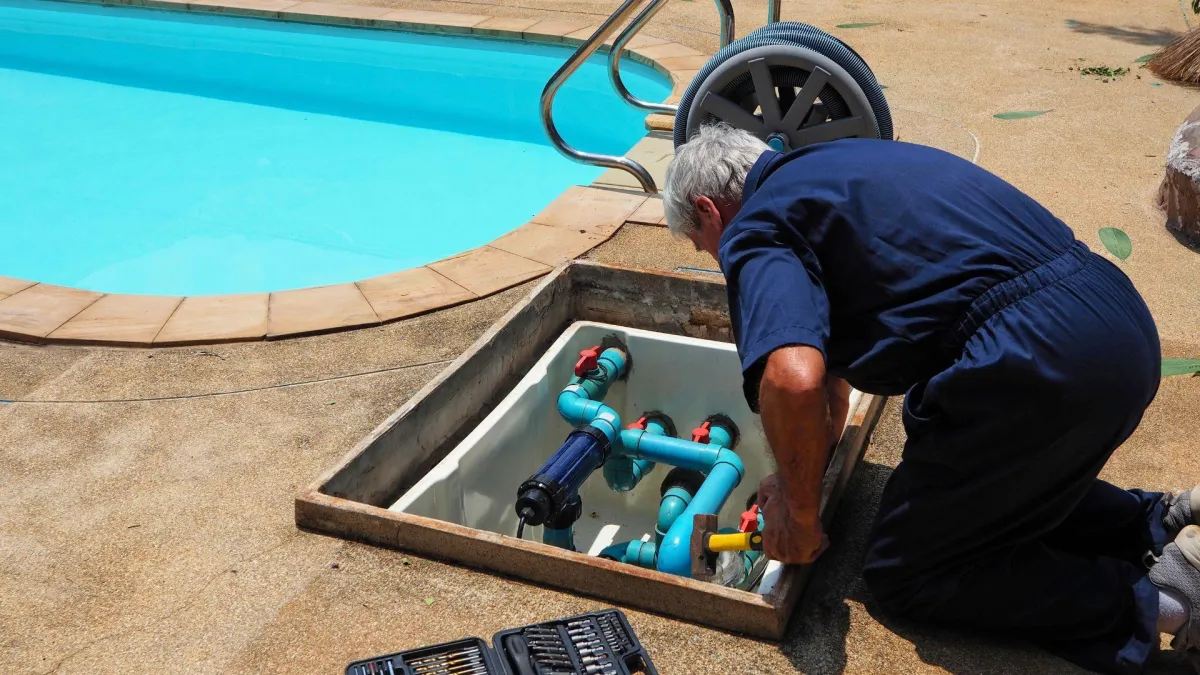
Under hot tub equipment repair we replace and rebuild heaters, pump wet ends and motors, blowers, air controls, valves, unions, spa lights, ozone and sanitizer gear, and the plumbing between all of it. Some of it is a part swap. Some of it is a rebuild. We tell you which one it is, and why, before we touch anything.
Hot tub equipment maintenance
Fixing a heater twice in three years is not bad luck. It is usually water chemistry nobody watched. A spa is a small body of very hot water, so everything moves faster in it. Chlorine burns off faster. Calcium drops out faster. pH swings faster. A pool can drift for a month and forgive you. A spa cannot.
Hot tub equipment maintenance is the boring work that keeps the expensive parts alive. We check and balance the water, clean or replace filter cartridges, look at the heater for early scale, check the pump seal for the first drips, run the jets and blower through a full cycle, and look at every union and fitting for the white crust that shows a slow leak.
We also drain and refill on a schedule that fits how much the tub gets used. Snowbird and second-home owners get a different plan than a family that soaks four nights a week. That is a conversation, not a package.
Hot tub test soaking
Anybody can swap a part and drive away. The question is whether the tub still works at ten at night, at full temperature, with four people in it.
Hot tub test soaking is how we answer that. After a repair, we fill the spa, bring it up to real soaking temperature, and let it run through a full heat cycle. Then we run the jets on high. Then the blower. Then we watch the panel for the same message that brought us out.
A heater can light once and still fail at temperature. A pump can prime cold and cavitate hot. A board can behave for ten minutes and fault at forty. Heat is what finds the second problem, and test soaking also catches the leak you did not see, because a joint that stays dry cold will often weep once the plumbing expands.
It adds time to the job. It is worth it. We would rather find it in your driveway than have you find it on a Saturday night with guests.
Spa heaters that will not light
This is our number one call, and it has more than one cause.
Sometimes the heater is fine and the flow is bad. The heater has a safety that refuses to fire if water is not moving through it. A clogged filter, a half-closed valve, a low water level or an air pocket will all lock it out. That is the cheap ending, and we check it first.
Sometimes it is gas. Gas spa heaters have igniters, gas valves, pressure switches and flame sensors, and any of them can go. A heater that clicks, tries, and gives up three times in a row is usually telling you it never saw flame.
Sometimes it is scale. On a gunite spa sharing a heater with the pool, valley water can pack the heat exchanger tight enough that the heater overheats itself and shuts down to protect the unit.
Gas piping, gas valve work and heater venting are licensed work in California. It is not a weekend project, and it is not a place to save money. Electrical bonding around a spa falls under California Electrical Code Article 680 and gets checked as part of any heater or equipment change we make.
Pumps, blowers and jets
The jets used to be stronger. We hear that every week, and it is almost never in your head.
Three things cause it. First, scale. Calcium narrows the small passages behind each jet face, and it does it unevenly, so one bench feels fine and the other feels dead. Second, air. A leak on the suction side of the pump pulls air in, and the pump moves foam instead of water. Third, the pump itself. Bearings get loud, impellers wear down, and seals start dripping onto the pad.
Blowers are their own animal. That deep bubbling comes from a separate air pump, usually mounted where the sun hits it. When a blower goes, it either gets very loud or goes silent. Jet faces themselves wear out too. The internal bearings seize, the face stops spinning, and the whole insert can be replaced without touching the plumbing behind it.
Blowing sand is a quiet part of this story. Fine desert grit rides in on the cover, settles into the footwell, and works its way into pump seals and jet bearings over the years. Rinsing before a soak helps more than people expect.
Spa-side controls and boards
A spa pack is a plastic box with a circuit board in it, sitting outside, in La Quinta, through a 115-degree summer. Then we ask it to run a heater. It is a hard life for electronics.
Boards fail in ways that look like other problems. A relay welds shut and the heater runs when it should not. A relay burns open and the heater never runs at all. A temperature sensor drifts and the board thinks the water is hotter than it is. The panel shows a message, the owner reads the message, and the message points at a part that is perfectly healthy.
That is why we test rather than guess. A new board on a tub that only needed a small sensor is a bad day for everybody. Topside panels fail too. Buttons stop responding, the display fades in the sun, or the ribbon cable corrodes where moisture found it. Sometimes the panel is the whole problem and the pack is fine.
The one thing we ask: do not keep resetting the breaker to clear a fault. If a board is faulting for a reason, it is protecting something.
Leaking spillways and shell joints
Raised spas that spill into the pool are everywhere in this valley, and they are lovely until they leak.
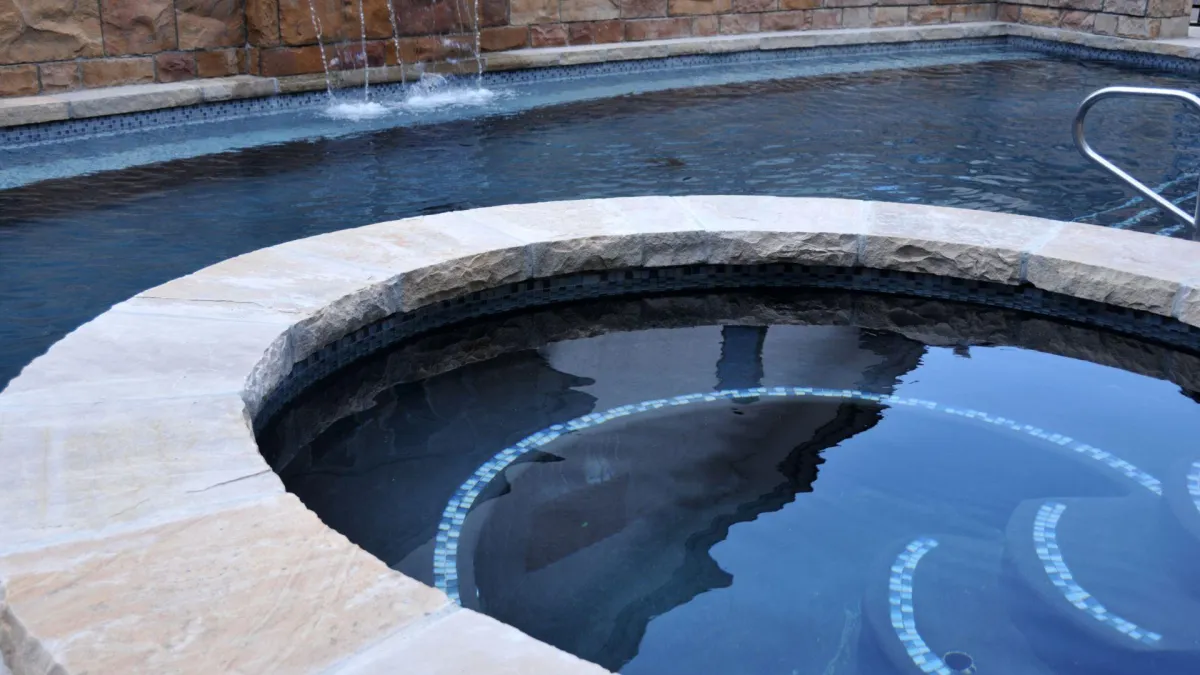
Water disappears from a spa in a few places. The spillway itself, where tile and stone meet the shell and the mortar behind it has cracked. The joint where the spa shell ties into the pool shell, which moves a little every year as the ground moves. The plumbing under the raised bond beam. And the equipment pad, where a dripping union or a weeping pump seal can lose a surprising amount of water in a week.
Heat makes all of it worse. Hot water finds gaps cold water will not, and a spa cycles hot and cool every single day.
The tell most owners notice first is that the spa drops but the pool does not, or the wall behind the spillway shows a dark stain that never dries. If the spillway stone stays damp when the spa has been off all day, something behind it is holding water. We track the leak down before we cut anything.
Attached gunite spas vs. standalone tubs
People use hot tub and spa to mean the same thing. The equipment does not.
An attached gunite spa is built into the pool. It shares plumbing, often shares a heater and pump, and the equipment sits on the same pad as everything else. Repairing one is pool work. It involves valves, actuators, shared heaters, bonding and sometimes the pool's control system.
A standalone portable tub is a self-contained acrylic shell with its own pack, its own pump and its own heater bolted underneath. Different parts, different access, different job entirely.
Our hot tub repair in La Quinta, CA work is built around attached gunite spas and their equipment pads, because that is what most valley homes have. Call the office and ask about standalone portable acrylic tubs before you book, so nobody wastes a trip.
If you are not sure which one you own, look for a hard plastic skirt around the whole tub. If it lifts off, it is portable. If it is stone or plaster, it is attached.
Where we are, and the spas we see around town
Our shop sits at 52115 Avenida Bermudas, right in La Quinta. That matters for spa work more than it does for anything else, because spa calls are urgent in a way pool calls usually are not. Nobody schedules a cold pool for next week and loses sleep. A cold spa on the night the family arrives is a different feeling.
Around Tradition Golf Club we see a lot of raised spillway spas on older equipment, where the spa and pool share a heater that has been quietly scaling for years. Out on the Andalusia Country Club fringe, the tubs are newer and the calls skew toward boards, sensors and actuator valves. At Codorniz, the homes are tighter together and the equipment pads are small, so access and neighbor noise both matter, and we plan for that.
A note on HOA rules. Several communities out here limit work hours, gate access and where a truck can park. Tell us the association and the gate when you book, and we will handle it on our end instead of sitting outside the gate calling you. Ask the office what this week actually looks like for response times.
Transform Your Backyard into a Stunning Oasis with Our
Pool Repair and Construction Services
Revitalize your outdoor space with expert repairs that make your pool look brand new.
You deserve peace of mind knowing your pool repairs are handled by trusted experts.
Pool Equipment Check-Up 1 year maintenance Check-Up package to ensure long-term satisfaction.
Hot tub repair in La Quinta, CA: questions we get every week
My spa panel is flashing a code. Can you tell me what it means over the phone?
Sometimes, roughly. Codes are not the same across brands, so we will not promise a diagnosis by phone. What helps is telling us the exact letters or numbers, whether the pump runs, and whether the water is cold or too hot. That usually gets us close enough to bring the right parts.
Why does my heater keep shutting off after a few minutes?
Nine times out of ten that is a flow problem, not a heater problem. The heater fires, then a safety sees weak water flow and shuts it down. Start with the filter and the water level. If those are fine, call us.
How much is a service call for a hot tub in La Quinta?
The diagnostic visit is $150. That is credited toward the repair if you approve the work. Repair cost after that depends on the part, and we quote it before we start.
Do you work on portable hot tubs, or only built-in spas?
Our work centers on attached gunite spas and their equipment pads. Call and ask about standalone portable acrylic tubs before booking, so we do not waste your time or ours.
My jets feel weaker than they used to. Is the pump dying?
Maybe, but check scale first. Our water is hard, and calcium builds up in the small passages behind the jets. If one bench feels strong and the other feels dead, that points to scale more than a failing pump.
The spa loses water but the pool level stays fine. What is that?
That usually means the leak is on the spa side: the spillway, the joint where the spa shell meets the pool, or the spa's own plumbing. It can also be a dripping union out at the equipment. We track it down before we cut anything.
Can I replace the heater myself?
Not the gas or the bonding side. Gas piping and the electrical bonding around a spa are licensed work in California, and a mistake there is dangerous, not just expensive.
We are only here in the winter. Can you get the spa running before we land?
Yes, and that is the smart way to do it. Give us your arrival date, and we will start it, run a full heat cycle and catch problems while there is still time to order parts.
My spa sat all summer without running. Is that bad?
It is common here and it is not the end of the world, but stale hot water and idle seals cause problems. Expect to drain, refill, balance and check the pump seal before the first soak of the season.
Do you handle the pool too, or just the spa?
Both. Most of the spas we service share equipment with a pool, so we are usually working on the whole pad anyway.
Facebook
Instagram
LinkedIn
Youtube