Our Passion is Transforming Your Backyard Vision into a Stunning Reality!
Next Door Neighborhood Favorite
Google and Yelp Reviews Below:

Licensed & Insured · Since 1998

Hot Tub Maintenance in La Quinta: The Four Numbers That Belong Inside Your Spa Cabinet Door

Proven Excellence
How often should a hot tub be serviced in the desert?
The first three minutes after you flip the breaker back on
Open the side panel of your spa. There is almost always a flat spot on the inside of that door. Tape an index card there and write four numbers on it. That card is the cheapest hot tub maintenance in La Quinta you will ever do, and it is the reason some spas run fifteen years and others die at seven.
Number one: the clean filter reading. On a spa with a pressure gauge, write the number the gauge shows the day the cartridge goes back in clean. On a spa without a gauge, write the date instead. Everything later gets measured against that mark.
Number two: calcium hardness. Test the water and write the result. Valley tap water comes out hard. If you top off all summer without ever testing, hardness climbs every month, because water leaves as vapor and the minerals stay behind.
Number three: the fill date. Spa water is not forever water. Write the day you last drained and refilled. Most people cannot remember, which is how a tub ends up three years deep in dissolved solids.
Number four: the heater's normal climb. Time how long the spa takes to gain ten degrees when everything is healthy. Write it down. Six months later, when it takes twice as long, you have proof instead of a feeling.
Four numbers. One card. Five minutes.
Here is why that card matters more here than it would in a mild climate. Our air is dry, our water is hard, and our wind carries sand. A spa in La Quinta loses water fast, concentrates minerals fast, and packs its filter fast. Nothing about that is dramatic on any single day. It is all slow, and slow is exactly what people miss.
Rinse the spa filter every two to four weeks, deep clean it every three months, and drain and refill every three to four months. Test water weekly while the spa is in use. In La Quinta, hard water and blow-sand shorten every one of those windows compared to what the owner's manual assumes.
Hot tub equipment maintenance in La Quinta



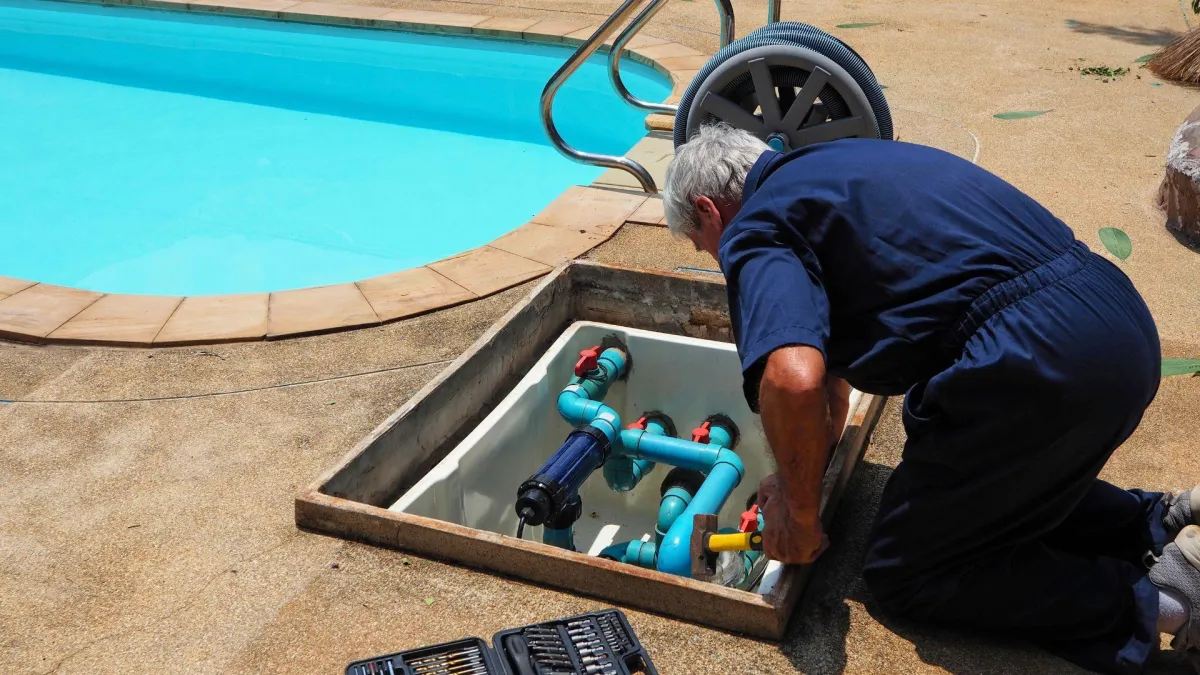
Hot tub equipment maintenance is service on the machinery before it fails, not after. A tune-up visit runs in a set order, because the parts feed each other.
Water first. We test hardness, pH, alkalinity and sanitizer. Hard water is the root of most spa equipment damage in this valley, so the chemistry reading tells us what to expect inside the heater before we ever open a panel.
Filter second. The cartridge comes out, gets inspected for stiff pleats, split seams and separated end caps, and gets a real cleaning. Rinsing with a hose knocks off dirt. It does nothing to calcium. A cartridge that has never been acid-soaked can look white and filter almost nothing.
Flow third. We check water level, prime, jet output and the flow switch. Low flow is the single most common reason a spa stops heating, and it is almost always a filter or a valve, not a heater.
Heat fourth. Burner, igniter, pressure switch and high-limit on a gas spa heater. Element and high-limit on an electric one. We look inside the heater tube for scale, because scale is an insulator and an insulated heater burns fuel to warm nothing.
Mechanical last. Pump seals, unions, gaskets, jet bodies, the blower intake, the air vents in the cabinet, and the pad itself. Sand in a cooling vent is a repair waiting six weeks to happen.
Then we write down what we found, in plain words, with anything that should be watched rather than replaced..
Hot tub equipment repair
Maintenance and repair meet at a line, and the line is worth naming.
Cleaning a scaled heat exchanger is maintenance. Replacing one that has been scaled for three years and now leaks is hot tub equipment repair. Tightening a weeping union is maintenance. Replacing a pump whose seal failed and dumped water into the motor is repair.
The pattern is simple. Maintenance fixes causes. Repair fixes consequences.
Things we see cross that line here:
Scale inside the heater. Starts as slower heating, ends as a failed exchanger.
A stiff, calcified cartridge. Starts as weak jets, ends as a burned-out pump seal from running dry.
Sand in the blower. Starts as a blower that gets hot, ends as a thermal cutout that never resets.
Low water in August. Starts as a gulping pump, ends as an air lock and a cooked impeller.
Ignored chemistry. Starts as cloudy water, ends as corroded jet hardware and a stained shell.
Every one of those has a cheap version and an expensive version, and the only difference is how many months passed.
If your spa has already crossed that line, the diagnostic path is on hot tub equipment repair in La Quinta. We are licensed under CSLB License 994121.
Water analysis
Water analysis on a spa is different from water analysis on a pool, and people who own both get caught by it.
A spa holds a few hundred gallons. A pool holds tens of thousands. Same bather, same sunscreen, same sweat but in a spa the load per gallon is fifty times higher. Then you heat it to 102 degrees, which speeds up every chemical reaction in the tub. A spa goes off the rails in days where a pool takes weeks.
What we test and why:
Calcium hardness. Ours starts high out of the tap. Low is bad too — soft water pulls minerals out of plaster and heater metal. There is a window, and it is narrow
pH. Hot water drives pH up on its own. High pH plus hard water is exactly how a tile line goes chalky gray.
Total alkalinity. The cushion that keeps pH from swinging. Without it, nothing you add stays put.
Sanitizer. Chlorine or bromine burns off fast at spa temperatures. A tub that tested fine Friday can read zero Sunday.
Total dissolved solids. The number that says the water is finished and needs replacing.
A spa in a La Quinta backyard also gets something a spa in a mild climate does not: evaporation on a scale that changes the chemistry by itself. Summer air past 115 degrees pulls water out fast, and every gallon that leaves as vapor leaves its minerals in the tub.
That is why hardness climbs even when you add nothing. Topping off is not neutral.
We offer pool water analysis in La Quinta as its own service for pools and spas together.
Summerization
Summerization is getting a spa ready for the stretch when the weather is working against it instead of with it.
Around here, summer is the season people stop using the spa. Nobody wants 102-degree water when the patio is 112. So the tub sits. And a sitting spa in a La Quinta June is not resting it is baking.
What a summerization visit covers:
Drop the set temperature, or shut the heater down entirely, and say so on the card inside the door.
Top off and check the autofill, because evaporation runs hardest exactly when nobody is watching.
Clean and inspect the filter, since a dirty cartridge left in hot standing water grows things.
Shade or ventilate the equipment enclosure. Motors and boards are air-cooled, and August air is not much of a coolant.
Screen the cabinet vents against blow-sand before monsoon season starts in July.
Set a realistic circulation schedule so water still turns over without running gear all day.
For second homes and snowbird properties that empty out in May, this visit matters more. Five months of nobody looking is how a small leak becomes a dry pump.
Related work on the pool side is covered under swimming pool services in La Quinta.
Winterization
Winterization means something different in the Coachella Valley than it does almost anywhere else, and it trips up people who moved here from colder places.
We do not close spas for winter. Winter is spa season. Our December and January nights drop toward freezing, the air is dry, and a hot tub at 102 degrees under a cold desert sky is the best it gets all year.
So winterization here is really a start-up:
Bring the spa back up after a summer of sitting, slowly, watching the start-up sequence instead of just flipping the breaker.
Drain and refill if the water has been standing since spring.
Replace the filter cartridge rather than clean it, if the pleats stiffened over the summer.
Check the cover. Desert sun destroys vinyl and foam, and a waterlogged cover doubles your heating cost overnight.
Inspect the heater fully, because this is the month it goes from idle to working every night.
Look for rodent damage in the equipment enclosure. Cool nights move mice into warm cabinets.
Freeze protection matters on the coldest nights. Most spa control packs have a freeze mode that runs the pump when the sensor reads low. On a spa that has been off all summer, nobody has tested that mode in months.
Cover work is detailed on pool cover repair in La Quinta
Want your spa on a maintenance schedule instead of a repair list?
Hot tub maintenance in La Quinta costs less than the repairs it prevents. That is the whole pitch, and it is not a complicated one.
Call (760) 619-2409. Monday through Friday, 8:00 AM to 5:00 PM. Shop at 52115 Avenida Bermudas, La Quinta, CA 92253. Online at cvpoolsrepair.com, or use our contact page for CV Pools in La Quinta.
A maintenance or diagnostic visit is $150, credited toward any repair you approve. Estimates on remodels, replaster, new builds and equipment upgrades are free.
Transform Your Backyard into a Stunning Oasis with Our
Pool Repair and Construction Services
Revitalize your outdoor space with expert repairs that make your pool look brand new.
You deserve peace of mind knowing your pool repairs are handled by trusted experts.
Pool Equipment Check-Up 1 year maintenance Check-Up package to ensure long-term satisfaction.
Questions People Actually Ask
How often do I really need to change spa water?
Every three to four months for a spa in regular use. Heavy use or a rental cuts that shorter. A simple rule: divide the gallons by ten, then divide by the number of people using it daily. That is roughly how many days the water has left.
My spa water goes cloudy two days after I shock it. Why?
Usually the filter, not the chemicals. A calcified cartridge stops filtering while still looking clean. Second suspect is total dissolved solids water that has been in the tub too long stops responding to anything you add.
Do I need to clean the filter if I barely use the spa?
Yes. Blow-sand and airborne dust load a cartridge whether anyone gets in or not. An unused spa in monsoon season can pack a filter faster than a used one in spring.
Is it cheaper to leave the spa hot all the time or heat it when I want it?
For most valley spas in winter, leaving it at temperature under a good cover costs less than reheating from cold, because reheating hundreds of gallons takes hours of full burner time. The cover is the variable. A waterlogged cover flips that math completely.
How do I know if my spa cover is shot?
Lift one end. If it feels noticeably heavier than it did new, the foam core has absorbed water and it is no longer insulating. Also look for split vinyl at the fold, which is where desert sun always attacks first.
What does a maintenance visit include?
Water testing, filter service, flow check, heater inspection, seal and union check, cabinet and vent cleaning, and a written list of what we found. $150, credited if it turns into an approved repair.
My spa smells funny even though the chlorine reads fine.
That is often biofilm inside the plumbing lines rather than a problem in the water itself. A purge product run through the jets before a drain and refill usually clears it. If the smell comes back within a month, there is something in the lines that needs a real look.
We close the house May through October. What should we do with the spa?
Drop or shut off the heat, top the water off, clean the filter, screen the cabinet vents against sand, and have someone look at it once during the summer. Five unwatched months is the most common way a small problem turns into a replacement.
Why is my calcium hardness going up when I never add calcium?
Why is my calcium hardness going up when I never add calcium? A: Evaporation. Water leaves as vapor, minerals stay behind, and you replace the water with more hard tap water. Hardness climbs on its own every time you top off.
Facebook
Instagram
LinkedIn
Youtube