
Licensed & Insured · Since 1998

Concrete Pouring in La Quinta: Rinse the Deck and Watch Where the Water Goes

Our Passion is Transforming Your Backyard Vision into a Stunning Reality!
Next Door Neighborhood Favorite
Google and Yelp Reviews Below:
Proven Excellence
Your slab already told you what it needs
Before anyone quotes you concrete pouring in La Quinta, go do something simple. Take a hose, wet down your existing deck or patio, and stand back for two minutes.
Water is the most honest inspector there is. Where it goes tells you what the slab is doing.
It runs off evenly and the surface dries in a uniform sheet. Your slope is fine and the concrete is dense and sound. Whatever is wrong is cosmetic.
It pools in the middle or at one edge. The slab has settled, or it was never sloped correctly. Low spots do not fix themselves, they get worse, because standing water keeps the subgrade beneath them wet and soft.
It runs toward the house. That is the one to take seriously. Everything else on the list is an annoyance. This one is a moisture problem waiting for a wet winter.
It disappears into a crack instead of running across it. The crack goes through the slab, not just across the surface, and it is feeding water into the base underneath.
One section dries fast and the section next to it stays dark for an hour. Different densities, which usually means a cold joint, a patch, or an area that cured badly.
Now look at the edges. Concrete near a lawn or a planter with daily irrigation almost always shows more movement than concrete in the middle of the yard, because the subgrade there never dries out. In a desert, the wettest soil on the property is the soil you water on purpose, and that is where slabs tilt.
Five minutes with a hose gives an experienced crew more useful information than a photo ever will. It also tells you whether you are looking at a resurfacing job, a partial replacement, or a full pour.
Can you pour concrete in Coachella Valley summer heat?
Yes, with adjustments. Hot weather shortens the working time before concrete sets, so pours get scheduled for early morning, crews are sized to place and finish faster, and curing is handled deliberately because the air pulls moisture out quickly. Fall through spring produces easier pours and generally a better finished surface.
Concrete pouring in La Quinta



Concrete pouring looks like one day of work. It is really four stages, and three of them happen before the truck arrives.
Stage one: the base
Excavation and grade
Old material comes out, the area gets cut to depth, and the grade gets set so water leaves the way you want it to.
Compaction
Loose soil under a slab is the single most common cause of early failure out here. Compacted base is not optional and it is not visible in the finished job, which is exactly why cheap bids skip it.
Stage two: forms, steel and joints
Forms set the shape and the elevation. Reinforcement, whether rebar, mesh or fiber, controls how the slab behaves once it cracks, because concrete cracks. Control joints decide where those cracks go, and spacing gets set against slab thickness and shape rather than by habit.
Anything that penetrates the slab gets isolated so it does not become a crack origin.
Stage three: the pour
Placement, screeding, floating, and then the finish: broom, trowel, salt, stamp or exposed aggregate. Heat compresses every one of those steps, which is why summer pours start early and run with more hands.
Stage four: curing
The step homeowners never see and the one that decides long-term strength. Concrete needs moisture to gain strength. In air this dry, letting a slab simply sit in the sun produces a weaker, dustier surface. Proper curing is a deliberate act here.
What gets poured on a typical valley property
Pool decks and patios
Walkways and side yards
Footings for walls, ramadas and outdoor kitchens
Equipment pads
Raised planters and seat walls
Driveway and approach sections
Estimates are free
The category page above this one is concrete contractor in La Quinta.
General repairs & maintenance
General repairs and maintenance on concrete is the honest half of this trade. A lot of what gets sold as replacement is repairable.
What is genuinely repairable
Hairline and surface cracking in a slab that is otherwise flat and stable. Routed, filled and, where it makes sense, resurfaced.
Joint failure. Old joint sealant that has dried out and pulled away. Reworking joints is cheap and it stops water from getting into the base.
Trip hazards at a lifted edge. Grinding or a leveling repair, depending on how much lift there is.
Spalling and surface wear on sound concrete. A resurfacing overlay covers it and gives a better surface than the original.
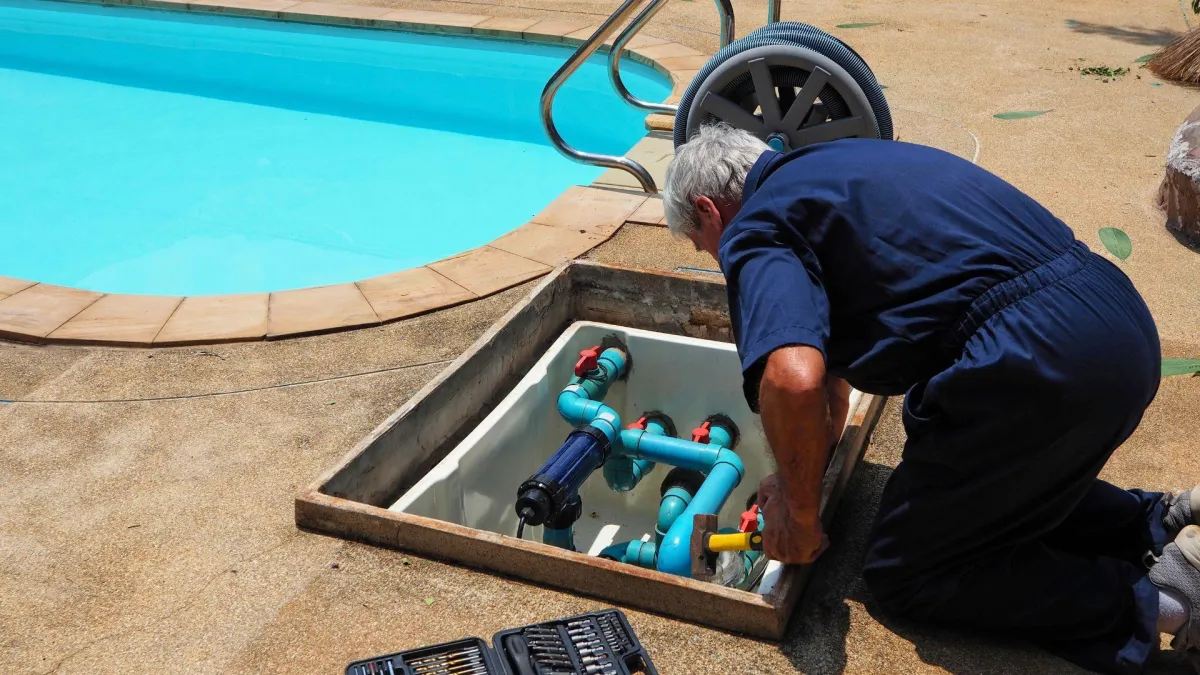
Equipment pad damage. A cracked or sinking pad under a heavy pump and filter assembly is a real problem and a small repair.
What is not worth repairing
A slab with wide cracks that are still moving, where the two sides sit at different heights.
A slab that has settled enough to change drainage direction.
Concrete poured too thin for what it now carries.
We will tell you which category you are in before quoting either one. An honest repair answer costs us a bigger job and keeps the customer, which is a trade we are comfortable making.
Pad work is on pool equipment repair in La Quinta.
Deck construction
Deck construction is where most concrete pouring in this valley ends up, and the pool edge adds requirements a patio does not have.
What changes when concrete meets a pool:
Coping. The transition piece takes splash-out, hard water, foot traffic and sun at a single point. It wears faster than anything else in the yard.
The expansion joint at the pool shell. Deck and shell move independently. That joint keeps them from fighting. When it fails, the deck pushes against the bond beam, and that is how coping lifts and tile cracks
Bonding. The electrical bonding grid around a pool covers deck reinforcement within a defined distance of the water, under California Electrical Code Article 680.
Barrier compliance. If deck work moves a gate, a wall or a grade, the pool barrier still has to comply afterward.
Surface temperature. The whole heat conversation, which lives on the deck page.
Full detail is on pool deck construction in La Quinta.
General Construction
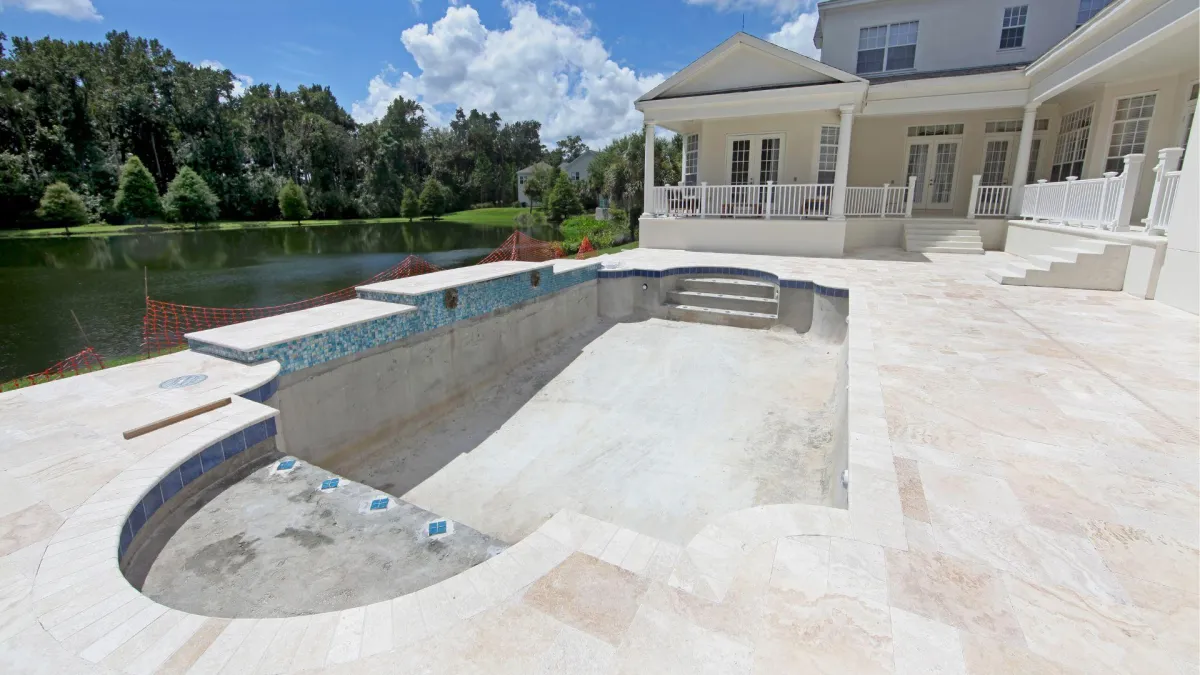
General construction is the usual shape of a real backyard project, where the pour is one step among several that have to happen in order.
A typical sequence when concrete is involved:
Demolition of whatever is coming out.
Underground first. Plumbing, gas sleeves, electrical conduit, drain lines and irrigation. Every one of these is cheap now and expensive later.
Footings for walls and structures
Structures, at least to the point where their footings are set.
Base prep across the whole area.
Pour and finish.
Finish trades on top: lighting, coping, tile, fixtures.
The rule that governs all of it: nothing that belongs under concrete gets decided after the concrete. A single conduit sleeve costs almost nothing during step two. Getting that same conduit under a finished slab means cutting, patching and a visible seam forever.
This is also why one contractor holding both the pool and general licenses saves real money on a backyard project. Fewer handoffs, one schedule, one set of permits.
Related work is on general contractor in La Quinta and pool renovations in La Quinta.
Do the hose test first
Wet the slab down before we come out. Take a photo of where the water sits. It answers half the questions we would otherwise have to ask.
Call (760) 619-2409. Monday through Friday, 8:00 AM to 5:00 PM. Shop at 52115 Avenida Bermudas, La Quinta, CA 92253. Online at cvpoolsrepair.com, or use our contact page for CV Pools in La Quinta. Everything we do is listed on swimming pool services in La Quinta.
Estimates on concrete, decks, remodels, replaster, new builds and equipment upgrades are free.
If your slab is pushing water toward the house, do not wait for winter.
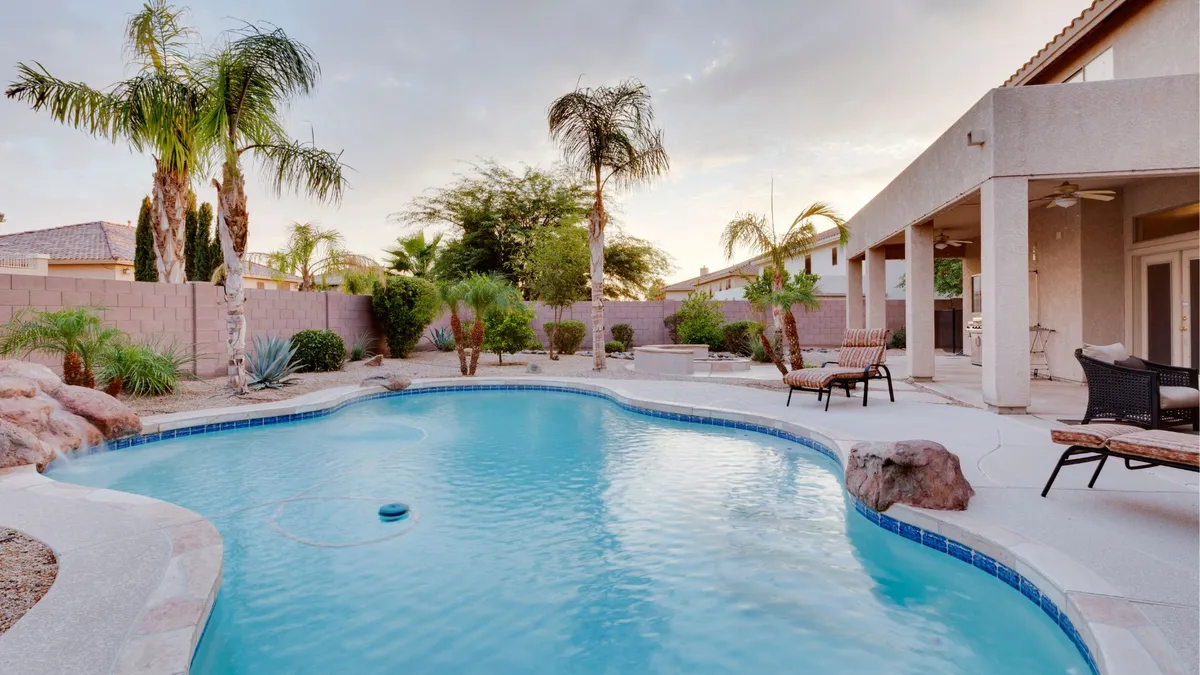
Transform Your Backyard into a Stunning Oasis with Our
Pool Repair and Construction Services
Revitalize your outdoor space with expert repairs that make your pool look brand new.
You deserve peace of mind knowing your pool repairs are handled by trusted experts.
Pool Equipment Check-Up 1 year maintenance Check-Up package to ensure long-term satisfaction.
Questions People Actually Ask
How thick should a pool deck slab be?
Thickness gets set against what the slab carries, how the soil behaves and how the joints are laid out, so a single number on a web page would be a guess about your property. What matters more than thickness alone is that thickness, reinforcement and joint spacing were chosen together.
My patio has cracks. Does the whole thing need replacing?
Usually not. Hairline and surface cracks in a flat, stable slab are repairable and often a good candidate for a resurfacing overlay. Wide cracks with a height difference between the two sides are a different answer, because the slab is moving.
Why do my slabs keep cracking near the planter?
Irrigation. The subgrade there stays wet, soft soil compresses under load, and the slab edge tilts. Fixing the drainage or moving the emitters matters as much as fixing the concrete.
What is a control joint and why does mine look cracked?
A control joint is a planned weak line, cut or tooled into the slab, that gives the concrete a place to crack where you will not mind. If the crack follows the joint, the joint did its job.
Can I pour new concrete over my old patio?
Sometimes, if the existing slab is sound and the added height does not create a problem at doors, thresholds or the pool edge. A bonded overlay is often the better version of this idea, because it adds much less height.
Can you pour a deck in the summer?
Yes, with adjustments. Shorter working windows, earlier starts and deliberate curing. It is doable. Fall through spring is easier and generally produces a better result.
How long before I can walk on it? Drive on it?
Walking comes first by a matter of days, vehicle loads take considerably longer, and the concrete keeps gaining strength well past that. We give the actual dates for your pour rather than general numbers, since they shift with mix, thickness and weather.
Will new concrete match my existing patio?
Close, not identical. Concrete cures to a color affected by mix, weather and age, and old concrete has weathered. Anyone promising an invisible match is overselling. Planning the seam at a joint line makes the difference much less noticeable.
Do you pour equipment pads?
: Yes, and it is a job worth doing right. Pumps and filters are heavy, they vibrate, and a cracked or sinking pad pulls plumbing out of alignment. It is a small pour with real consequences.
Is stamped concrete a bad idea in the desert?
Not bad, just warmer in dark colors. The pattern is fine. The color is the decision. Pair a darker stamp with shade or keep the dark colors off the areas people cross barefoot.
Facebook
Instagram
LinkedIn
Youtube